Yerba Mansa
Anemopsis californica
A white-bracted flower of desert springs and riverbanks, with a spicy, medicinal-smelling root.
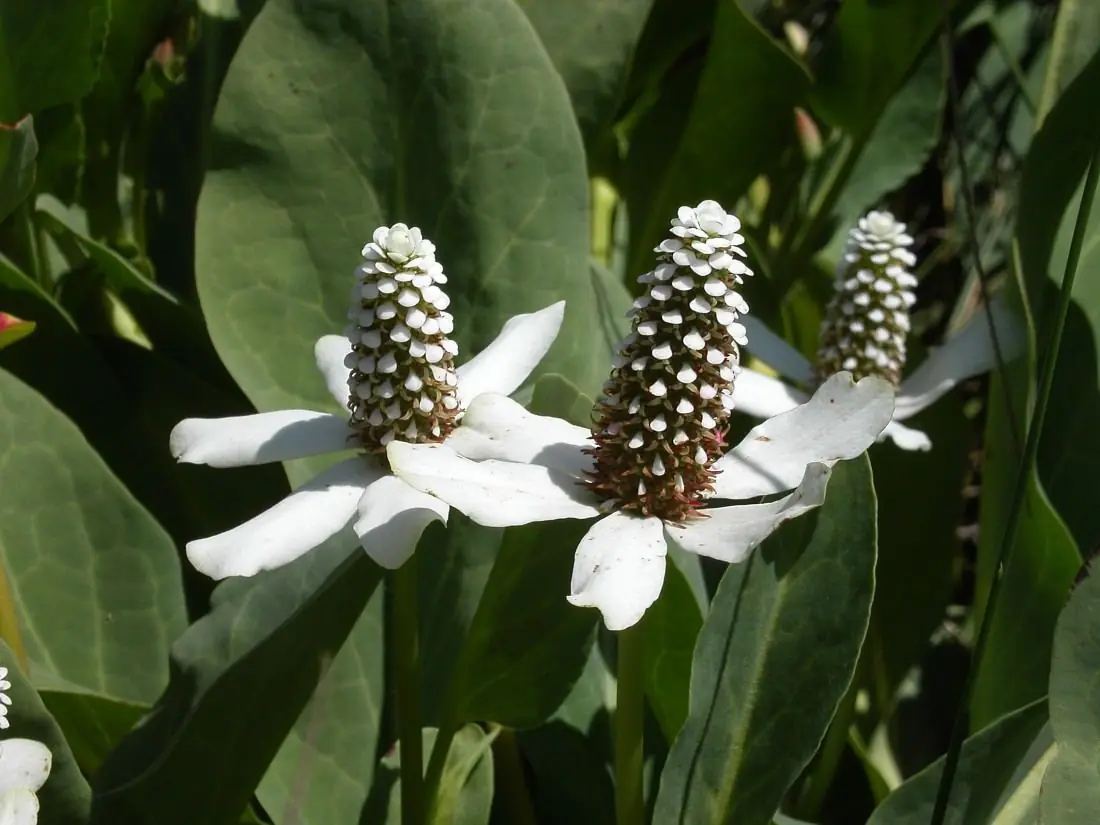
Yerba mansa grows in wet, salty ground along springs and desert rivers across the Southwest. Its flowers look like white anemones with a cone in the middle, and its root smells sharply of eucalyptus and camphor. Paiute, Cahuilla, Pima, Yokuts, and many other peoples used the root for colds, sore throats, wounds, and sore muscles, and it remains a staple of Hispanic New Mexican folk medicine.
Traditional profile
Actions
- antimicrobialActs against bacteria, fungi, or other microbes, at least in the lab.
- astringentTightens and dries tissue; the puckery feel of strong tea, from tannins.
- anti-inflammatoryUsed to calm swelling, redness, and heat in tissues.
- aromaticRich in fragrant oils, which tend to settle the stomach and clear the head.
Body systems
Native nations kept their own medical knowledge. The uses here are those published in ethnobotanical records.
How to know it
A low perennial with large, oval, long-stemmed leaves in a basal rosette and runners that root into mats. The “flower” is a cone of tiny flowers above a collar of five to eight white bracts, often spotted red with age. Leaves turn red in fall.
It is the only species in its genus. The whole plant, and especially the thick root, has a spicy, camphor-like smell when broken.
History & lore
USDA records credit the Kawaiisu and Tübatulabal with a hot root tea for colds and coughs, the Yokuts with root water for a bad stomach, the Costanoan with a root decoction for cramps and pain, the Cahuilla with a remedy for pleurisy, the Shoshone with root poultices for swellings, the Moapa Paiute with leaf baths for sore muscles and feet, the Pima with a root tea for colds, and the Kamia with seeds ground and cooked as mush.
Yerba mansa means roughly “gentle herb” in Spanish. In New Mexico and southern Colorado it is one of the most trusted herbs of curanderas, used much as goldenseal is used in the East.
Growing it
It needs moist to wet soil and tolerates salt and alkaline ground that few plants will. Grow it in a pond margin, a rain garden, or a pot kept in a saucer of water. In the right spot it spreads quickly by runners.
Varieties & companions
There are no named varieties. In the wild it grows with sedges, rushes, saltgrass, and seep willow. United Plant Savers counts it among its at-risk and to-watch plants because springs and wetlands across its range are drying up.
Gathering & drying
Dig roots in fall after the leaves redden, taking only part of a patch so the runners can fill back in. Wash, slice, and dry them. Leaves can be picked any time and dried for baths.
At the hearth
Root tea as a gargle for sore throats and a drink for colds; powdered dried root sprinkled on cuts and sores; leaf baths for aching feet and muscles.
In the kitchen
Yerba mansa isn’t a kitchen herb today. The Kamia ground its seeds for mush, but the root and leaves are too strongly flavored to eat.
Traditional usage
Root as tea, gargle, poultice, and powder; leaves in baths and poultices. Recorded uses focus on colds and coughs, sore throats, wounds, swellings, stomach upsets, and muscle pain.
Native nations kept their own medical knowledge. The uses here are those published in ethnobotanical records and credited to the nations named.
Chemical constituents
The root oil is rich in methyleugenol, thymol, piperitone, elemicin, and 1,8-cineole, which together give its sharp smell. The root also contains lignans and tannins.
What the research says
There are no clinical trials of yerba mansa. Lab studies show its root extracts and oil have antimicrobial and anti-inflammatory activity.
Its oil contains methyleugenol, which has caused cancer in rodents at high doses, so long-term heavy use is best avoided and it isn’t recommended in pregnancy.
Good to know
Buy cultivated yerba mansa or grow your own rather than digging wild stands, which are shrinking along with the springs they depend on.
Further reading
- USDA NRCS Plant Guide: Yerba mansaRange, growing, and recorded uses by named nations.
- United Plant Savers: Yerba mansaConservation status and ecology.
- Yerba Mansa Project: Anemopsis californica monographHistory, chemistry, and restoration.