Mesquite
Prosopis velutina
The desert’s bread tree: sweet pods ground into flour for thousands of years.
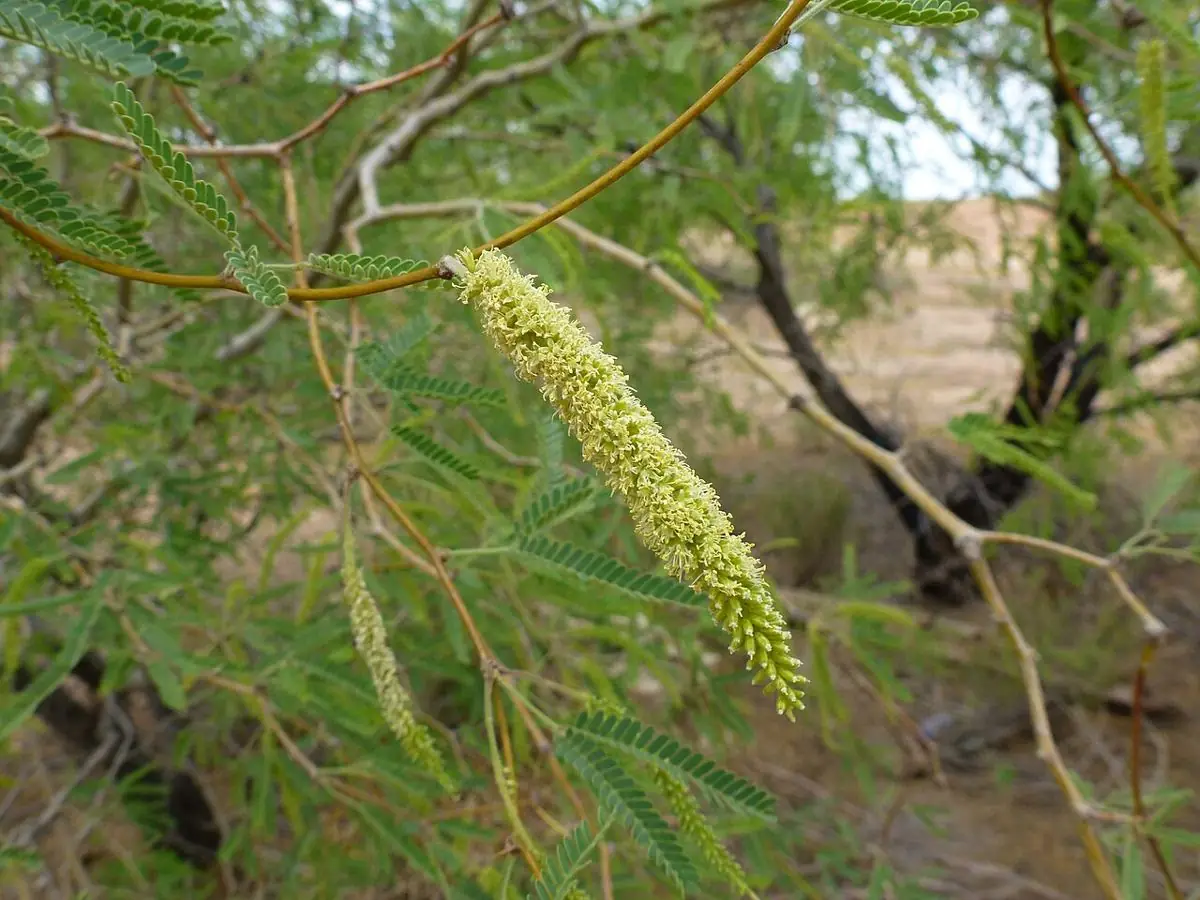
Velvet mesquite lines washes and grasslands across southern Arizona, including the San Pedro Valley. Its sweet, beige pods ripen in early summer, and for thousands of years O’odham, Hohokam, Piipaash, and other desert peoples ground them into a flour that may have mattered more to them than corn. The black gum, the wood, and the flowers all had uses too.
Traditional profile
Actions
- nutritiveA food-like herb, rich in vitamins or minerals.
- demulcentCoats and soothes irritated tissue with slippery mucilage.
- astringentTightens and dries tissue; the puckery feel of strong tea, from tannins.
Body systems
Native nations kept their own medical knowledge. The uses here are those published in ethnobotanical and archaeological records.
How to know it
A small, spreading tree or shrub with dark, rough bark, paired thorns, and feathery leaves divided into many small leaflets. Yellow catkin-like flower spikes in spring become long, flat, bean-like pods that ripen to tan or striped red-tan in June and July.
Velvet mesquite has fine hairs on its leaflets. Honey mesquite (P. glandulosa) is its eastern neighbor, and screwbean mesquite has tightly coiled pods.
History & lore
Archaeologists find mesquite among the top plant remains at nearly every Hohokam village. The Tohono O’odham calendar includes a Mesquite Bean Harvest Moon, and families pounded pods in bedrock mortars, a group job mostly done by women. A government report from 1871 described the Akimel O’odham and Piipaash gathering millions of pounds of pods a year.
Flour was baked into dense cakes, stirred into atole, and pressed into hard cakes that kept for years. Potters painted black designs with boiled mesquite sap, the Akimel O’odham used the gum for sore lips, chapped hands, and to dye hair, and the Cahuilla dug wells where mesquite grew because it signaled water underground.
Growing it
Plant in full sun in deep soil; mesquite sends a taproot far down and needs little water once established. It fixes nitrogen and shades the ground beneath it. Prune in summer, not winter, and keep the canopy open so monsoon winds don’t topple it.
Varieties & companions
Velvet mesquite is the native choice for southern Arizona; thornless South American hybrids are common in cities but are less hardy and less useful for food. Honey mesquite is the choice in Texas and New Mexico.
Mesquite shade shelters wolfberry, chiltepin, and other plants that need a nurse tree. Its flowers are a major source of honey.
Gathering & drying
Pick pods from the tree, not the ground, when they are dry and snap cleanly, and taste one: some trees are much sweeter than others. Pods on the ground can grow mold. Dry them further in the sun, then take them to a hammermill (community millings are held in Tucson and elsewhere) or grind small batches in a strong blender and sift.
At the hearth
The pods were chewed fresh as a sweet snack. The gum was a salve for chapped skin and sore lips, and leaves were placed on stings. Mesquite wood is still the favorite cooking fuel of the region.
In the kitchen
Mesquite flour is sweet, nutty, and a little like cinnamon and caramel. Use it for up to a quarter of the flour in pancakes, cookies, and bread, or stir it into warm milk as atole. It burns easily, so bake at slightly lower heat.
Traditional usage
Pods as a staple food and drink, gum as medicine, glue, paint, and dye, leaves as a poultice, bark and wood for fuel and building. Records mention sore lips and gums, chapped hands, pink eye, and stings.
Native nations kept their own medical knowledge. The uses here are those published in ethnobotanical and archaeological records and credited to the nations named.
Chemical constituents
The pod pulp is mostly sugar, largely sucrose, plus soluble fiber; the hard seeds hold protein and a galactomannan gum similar to guar. The gum from the bark is a complex polysaccharide much like gum arabic, and the bark and leaves contain tannins and flavonoids.
What the research says
There is little human research on mesquite. Its fiber and gum slow sugar absorption in lab tests, and people often call it low-glycemic, but that hasn’t been well tested in people.
Mesquite pollen can trigger spring allergies. The thorns are sharp enough to puncture tires.
Good to know
Harvest from trees away from busy roads and sprayed areas, and don’t collect pods from the ground after rain.
Further reading
- USDA NRCS Plant Guide: Velvet mesquiteRange, growing, and recorded uses by named nations.
- Archaeology Southwest: A Brief Cultural History of MesquiteO’odham, Hohokam, Piipaash, and Cahuilla uses.
- Savor the Southwest: Mesquite milling at Mission GardenHow pods are milled in Tucson today.