Yarrow
Achillea millefolium
Feathery foliage under flat-topped flower clusters, named after Achilles in the old herbals.
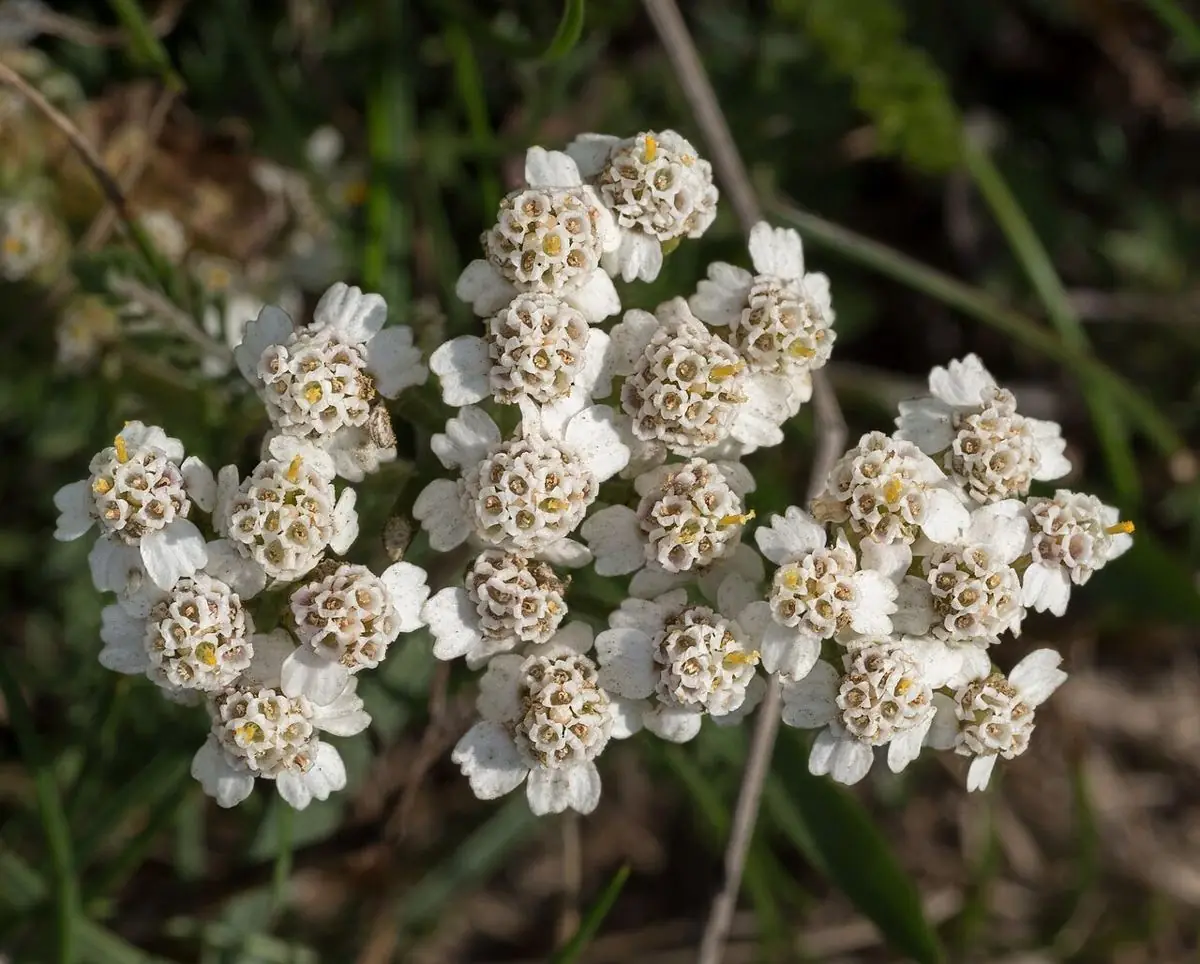
Yarrow’s lace-like, almost fern-fine leaves give the plant its old byname of “thousand-leaf,” and its flat clusters of tiny white or pink flowers are built for exactly the pollinators you’d want in a kitchen garden. The old herbals tied it to Achilles and his soldiers, and household tradition has long kept a bundle drying in the shed for scrapes and rough garden work. It tolerates neglect better than almost anything else on this list.
Traditional profile
Actions
- diaphoreticBrings on a sweat; used at the start of a cold or fever.
- astringentTightens and dries tissue; the puckery feel of strong tea, from tannins.
- vulneraryHelps wounds heal.
- bitterStrongly bitter; taken before meals to wake the appetite and digestion.
Body systems
Culpeper (1653)
- Ruling planet
- Venus
How to know it
A perennial one to three feet tall with a single tough stem and long, narrow leaves cut into so many tiny segments they look like feathers or a fern. The flowers sit in a broad, flat-topped cluster made of dozens of tiny heads, each with about five short petals: white in the wild, pink or colored in garden kinds. Crushed leaves have a sharp, spicy smell.
Learn it well before gathering it wild. From a distance, the white flat-topped flower heads can be mistaken for the umbels of poison hemlock and water hemlock, which are deadly. Yarrow’s feathery leaves, its lack of hollow, purple-blotched stems, and its many little daisy-like florets set it apart.
History & lore
The genus is named for Achilles, who by legend stanched his soldiers’ wounds with it, and one of its old Latin names was herba militaris, the military herb. English country names tell the same story: soldier’s woundwort, knight’s milfoil, staunchweed. “Old man’s pepper” came from the sharp taste of the leaves, and “nosebleed” from a double reputation for both stopping and starting them.
It was a love-charm plant. Grieve records a rhyme for tickling the inside of the nose with a leaf: “Yarroway, yarroway, bear a white blow, / If my love love me, my nose will bleed now.” In Sweden it was called “field hop” and brewed into beer, and dried yarrow stalks are the traditional tool for casting the Chinese I Ching.
Growing it
Yarrow grows in full sun in almost any well-drained soil and handles drought, heat, and poor ground without complaint. It spreads by underground runners, so give it room or lift and divide clumps every few years.
It draws in hoverflies, ladybugs, and small wasps, which is part of why it has always been welcome at the edge of a vegetable bed.
Varieties & companions
For herbal use, stick with the white-flowered wild type. Garden cultivars such as ‘Paprika’, ‘Cerise Queen’, and the ‘Summer Pastels’ mix come in reds, pinks, and yellows; ‘Moonshine’ and the tall fernleaf yarrow (A. filipendulina) ‘Gold Plate’ are different plants grown for looks.
Yarrow is one of the best plants for drawing ladybugs, lacewings, hoverflies, and tiny parasitic wasps to a vegetable garden, and it holds dry, poor corners where little else will grow. Gardeners have long added a few leaves to the compost heap to get it working.
Gathering & drying
Cut the flowering tops, with a few inches of leafy stem, when the clusters are fully open and before they start to brown. Hang them in small bundles in a shaded, airy place; they dry quickly and keep their shape well.
At the hearth
Yarrow’s old place in the household is as a rough-and-ready garden herb: dried bundles hung in the shed, and fresh leaves crushed and pressed onto a scrape while working outside. It also went into strewing mixes and was used in some regions to flavor ale before hops were common.
In the kitchen
The leaves are strongly bitter and aromatic. A few very young leaves can go into a mixed salad, and the herb turns up in some bitters and herbal liqueurs, but it is mostly a garden and shed herb rather than a kitchen one.
Traditional usage
The flowering tops are the part used. Crushed fresh leaves were pressed onto small cuts outdoors. A hot infusion of the dried tops, about a teaspoon or two per cup, was a traditional drink at the start of a cold to bring on a sweat, often mixed with elderflower and peppermint in the old “yarrow, elder, and mint” tea.
It was also taken as a bitter before meals to wake up the appetite, and the leaves were used in snuff.
Chemical constituents
Yarrow’s essential oil varies a great deal between wild populations. It can contain 1,8-cineole, camphor, borneol, β-pinene, and sabinene, and some plants yield a blue oil because they contain proazulenes that turn into chamazulene when distilled, the same blue compound found in chamomile.
The bitterness comes from sesquiterpene lactones such as achillin and leucodin, which are also behind most skin allergies to the plant. There are also flavonoids (apigenin, luteolin), phenolic acids, tannins, and small amounts of the alkaloid-like compounds achilleine and stachydrine.
What the research says
There is very little research on yarrow in people. Most studies are lab and animal work showing anti-inflammatory, antispasmodic, and antibacterial activity, and a few small human trials that are hard to draw conclusions from.
European regulators list yarrow as a traditional herbal medicine for poor appetite and mild digestive complaints, mild menstrual cramps, and small superficial wounds, based on long use rather than clinical evidence.
Allergic skin reactions are the main reported risk, especially for people sensitive to daisy-family plants.
Good to know
Another daisy-family plant, with the same ragweed-family cautions as chamomile and calendula.
Further reading
- European Medicines Agency: Yarrow herb herbal summaryWhat European regulators accept as traditional use, and why.
- Ali et al., Phytotherapy Research (2017): yarrow reviewReview of yarrow chemistry and pharmacology.
- Mrs. M. Grieve, A Modern Herbal (1931): YarrowOld names, charms, and uses.
- Nicholas Culpeper, The Complete Herbal (1653)Free public-domain copy at Project Gutenberg.