Elderflower & Elderberry
Sambucus nigra
One shrub, two harvests — creamy flower umbels in June, then dark berries by September.
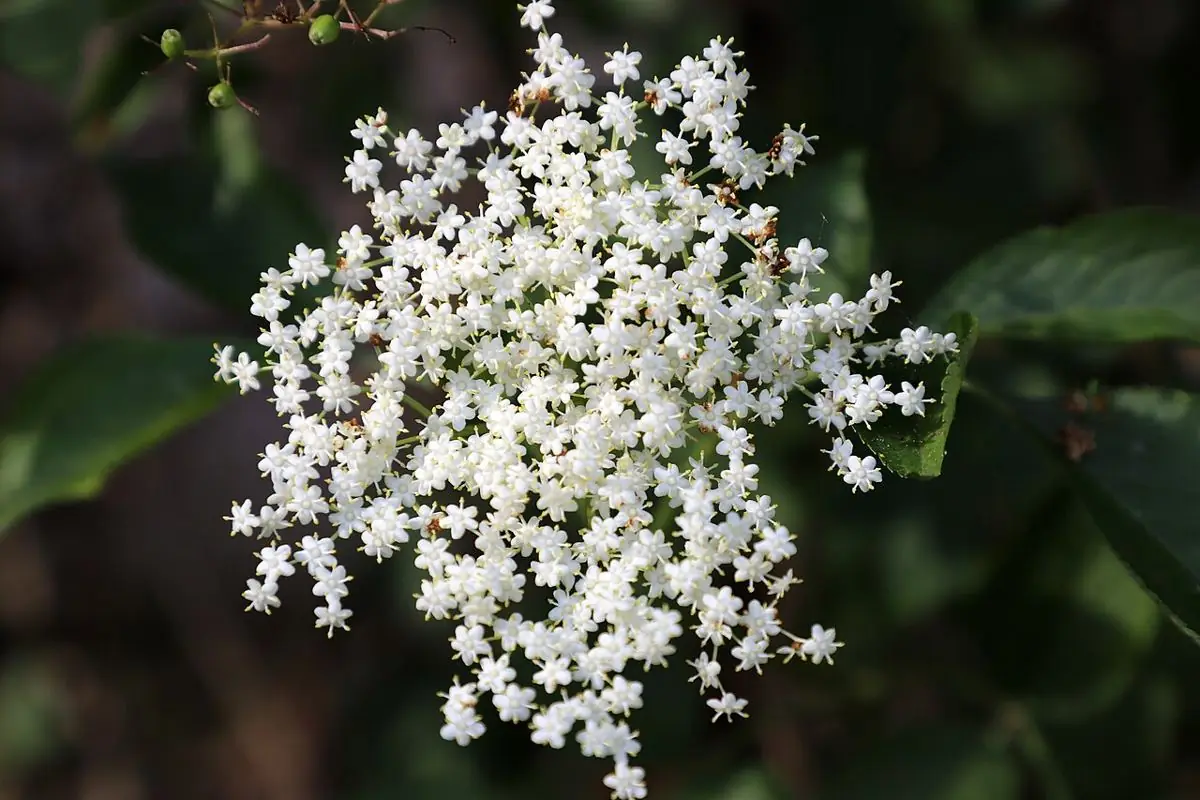
The elder gives two entirely different gifts from the same branch: broad, lacy white flower umbels in early summer that are steeped into cordial, and clusters of deep purple berries a few months later that are simmered down into syrup. The raw berries and stems are not eaten, and only the cooked fruit is used, which is exactly why the elderberry syrup pot has been a September kitchen ritual in cold climates for generations.
Traditional profile
Actions
- diaphoreticBrings on a sweat; used at the start of a cold or fever.
- nutritiveA food-like herb, rich in vitamins or minerals.
- antioxidantRich in compounds that protect cells from oxidative damage.
Body systems
Culpeper (1653)
- Ruling planet
- Venus
How to know it
A large shrub or small tree, often ten to twenty feet tall, with gray, corky, bumpy bark and stems full of soft white pith. The leaves grow in opposite pairs and are divided into five to seven toothed leaflets. In late spring it carries flat, plate-sized clusters of tiny cream flowers with a sweet, musky scent, followed by drooping clusters of small, shiny purple-black berries.
The American elder (Sambucus canadensis) is very similar and used the same way. Red elder, with dome-shaped clusters of red berries, is not the one to gather for the kitchen.
History & lore
Grieve traces “elder” to the Anglo-Saxon æld, fire, because the hollowed young stems were used to blow up a fire; the Scots called it the bour tree or bore tree. Sambucus is thought to come from the sambuca, an ancient musical instrument, and Pliny wrote of Roman pipes made from elder wood.
In Danish and English folklore an Elder Mother (the Danish Hyldemoer) lived in the tree, and it was wise to ask her leave before cutting any wood: “Lady Ellhorn, give me some of thy wood and I will give thee some of mine when it grows in the forest.” Elder was said to keep witches and lightning away from a house, and cradles were never made of it. A medieval legend held that Judas hanged himself on an elder, which is how the ear-shaped fungus that grows on its bark got its old name.
The diarist John Evelyn wrote in 1664 that if the elder’s virtues were fully known, there would be no ailment a countryman couldn’t find a remedy for “from every hedge.”
Growing it
Elder grows fast in moist, reasonably rich soil in sun or part shade, and it is at home along hedgerows, ditches, and field edges. It fruits best in sun. Planting two different varieties near each other usually gives a heavier crop of berries.
Old stems can be cut out at the base every few years to keep the bush productive and within reach.
Varieties & companions
For fruit, the Austrian variety ‘Haschberg’ is a heavy cropper of European elder, and American elder (S. canadensis) varieties such as ‘Adams’, ‘York’, and ‘Bob Gordon’ are widely grown in North America; plant two different ones for better berry set. ‘Black Lace’ and ‘Black Beauty’ are ornamental elders with dark leaves and pink flowers, and their flowers and berries can be used the same way.
Elder belongs in a mixed hedgerow with hawthorn, wild rose, and hazel. Its flowers feed many insects, and birds will strip the berries if you don’t net them.
Gathering & drying
For flowers, cut whole umbels on a dry, sunny morning when most of the tiny flowers are freshly open and smell sweet rather than stale. Shake them gently to dislodge insects. Use them the same day, or dry them face-down on paper and rub the dry flowers off the stalks.
For berries, cut the whole cluster when every berry has turned dark purple-black. Strip the berries off with a fork — freezing the clusters first makes this easier — and pick out any green berries and bits of stem. Berries can be dried on screens or in a low oven, or frozen.
At the hearth
The berries go into syrup every September, and the flowers into cordials and a mild flower water that older households used as a face wash. The hollow stems, once the pith is pushed out, were used as whistles, blowpipes for the fire, and taps for sap.
In the kitchen
Elderflowers are steeped with sugar and lemon into cordial, dipped whole in batter and fried as fritters, or added to gooseberry jam. The cooked berries go into syrups, jellies, pies, and country wine.
Traditional usage
Both flowers and ripe berries were used, and each had its season. A hot infusion of dried elderflower, about two teaspoons per cup, was a classic drink at the first sign of a cold, often combined with yarrow and peppermint. Elderflower water was a gentle skin and eye wash.
The ripe berries were simmered into syrups, rob (a thick boiled-down juice), jellies, and wine, taken through the winter. Older herbals also describe the leaves and bark being used as strong purges and in ointments for bruises, but those parts are toxic and aren’t used in home kitchens.
Chemical constituents
Elderflowers contain flavonoids, mainly rutin, isoquercitrin, and other quercetin and kaempferol glycosides, plus chlorogenic acid and a small amount of fragrant essential oil.
The berries are colored by anthocyanins, chiefly cyanidin-3-sambubioside and cyanidin-3-glucoside, and also contain vitamin C, fruit acids, and pectin.
The leaves, stems, bark, roots, seeds, and unripe berries contain cyanogenic glycosides, chiefly sambunigrin, which can release small amounts of cyanide. Cooking the ripe berries breaks these down, which is why raw elder upsets the stomach and cooked elder doesn’t. Elder bark also contains lectins, one of which is used in laboratories to identify certain sugars on cells.
What the research says
NCCIH reports that some early research suggests elderberry may ease symptoms of flu, colds, and other upper respiratory infections, but only a few small studies exist, and there is no good evidence it helps prevent or treat COVID-19. Little research has been done on other uses.
European regulators list elderflower as a traditional herbal medicine to relieve early symptoms of the common cold, noting that there are no clinical studies behind it and that no side effects had been reported.
NCCIH warns that raw or unripe berries and other parts of the plant can cause nausea, vomiting, and severe diarrhea, and that cooking removes the problem. Its safety in pregnancy isn’t known.
Good to know
The leaves, stems, bark, roots, and unripe green berries are not eaten, and the ripe berries are used only after cooking. Raw elder can cause nausea and stomach upset, which is why every berry recipe here involves a long simmer.
Further reading
- NCCIH: European ElderResearch and safety summary, updated 2024.
- European Medicines Agency: Elder flower herbal summaryWhat European regulators accept as traditional use, and why.
- Mrs. M. Grieve, A Modern Herbal (1931): ElderNames, the Elder Mother, and old recipes.
- Nicholas Culpeper, The Complete Herbal (1653)Free public-domain copy at Project Gutenberg.