Nettle
Urtica dioica
It stings fresh and forgives completely once cooked or dried, and it’s the earliest green of the spring garden.
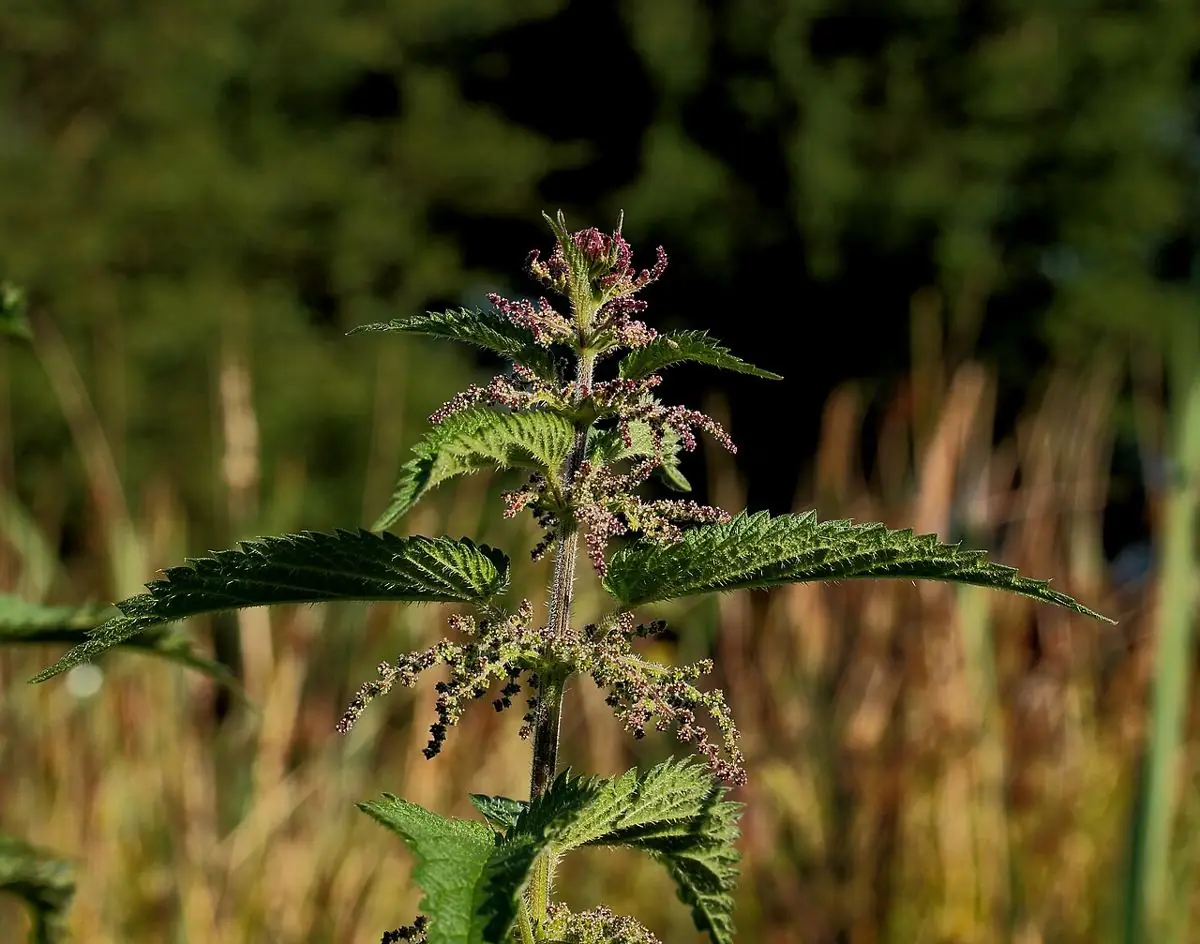
Nettle earns its reputation the moment bare skin brushes it fresh, but that sting disappears entirely with heat or drying, which is why it has stayed on the foraging list for so long despite the warning label. The young spring shoots are gathered with gloves and treated much like spinach, and the dried leaf makes a mineral-rich, faintly grassy tea that’s traditionally taken as a general spring tonic after a long winter.
Traditional profile
Actions
- nutritiveA food-like herb, rich in vitamins or minerals.
- diureticIncreases the flow of urine.
- astringentTightens and dries tissue; the puckery feel of strong tea, from tannins.
Body systems
Culpeper (1653)
- Ruling planet
- Mars
How to know it
An upright perennial, three to six feet tall by summer, with square, unbranched stems and pairs of heart-shaped, coarsely toothed leaves that end in a point. Stems and leaves are covered in fine stinging hairs. From midsummer, thin strands of tiny greenish flowers hang from where the leaves meet the stem.
Nettles grow in dense patches wherever the ground is rich — around old farmyards, compost heaps, and stream banks. Dead-nettles (Lamium) look similar but have no sting and carry small hooded purple, white, or yellow flowers.
History & lore
Nettle is one of the oldest fiber plants in Europe. Cloth from a Bronze Age burial at Voldtofte in Denmark, about 2,800 years old, turned out to be woven from nettle fiber that was probably grown in what is now Austria. Scotland made nettle sheets and tablecloths into the 1700s, and Germany gathered millions of pounds of nettles for cloth when cotton ran short in the First World War.
The antiquarian William Camden recorded a story that Roman soldiers sowed nettles in Britain so they could rub their stiff limbs with them in the cold. Samuel Pepys wrote in his diary in 1661 that “we did eat some nettle porridge, which was very good,” and in Hans Christian Andersen’s The Wild Swans the princess weaves shirts of nettle to break her brothers’ curse.
Country children learned the charm “Nettle in, dock out” for rubbing a dock leaf on a sting.
Growing it
Most people gather nettles rather than plant them, but a patch in a back corner is easy to keep: moist, rich soil and a little sun are all it needs. It spreads by tough yellow roots, so a sunken edging or a mowed border keeps it where you want it.
A nettle patch is also a nursery for peacock and red admiral butterfly caterpillars.
Varieties & companions
The perennial stinging nettle (U. dioica) is the one for gathering. The small annual nettle (U. urens) is shorter, stings harder, and was used the same way. A nearly stingless fen nettle (U. dioica subsp. galeopsifolia) grows in wet places in Europe.
A nettle patch feeds the caterpillars of peacock, red admiral, small tortoiseshell, and comma butterflies. Its early aphids also feed the first ladybugs of the year, which then move on to the rest of the garden.
Gathering & drying
Wear gloves and long sleeves. In spring, snip the top four to six leaves of young plants before they start to flower; the tops are tender and the stems still soft. Cutting a patch back hard in midsummer brings up a second flush of fresh tops to gather in autumn.
Use fresh nettles the same day, or dry them in loose bundles or spread on screens. Once fully dry they no longer sting and can be crumbled into a jar.
At the hearth
Dried leaf is steeped as a green, grassy tea, the traditional spring tonic. Outside the kitchen, nettle stems were once retted and spun into a linen-like cloth, the leaves give a soft green dye, and a bucket of nettles steeped in water for a couple of weeks makes a strong-smelling liquid feed for the garden.
In the kitchen
Blanch the tops for a minute to take away the sting, then use them anywhere you would use spinach: soups, pesto, omelets, risotto, and savory pies. Nettle soup with potato and a little cream is the classic first green meal of spring.
Traditional usage
The young tops and leaves are the parts most used. Dried leaf was steeped as a spring tonic tea, one or two teaspoons per cup, and fresh tops were cooked as a green. The fresh plant was also used on purpose to sting aching joints, an old practice called urtication.
Nettle tea was used as a hair rinse and nettle juice as a scalp wash. Outside the house, the fibers were spun, the leaves dyed wool green, and nettles steeped in water made a strong liquid fertilizer.
Chemical constituents
Each stinging hair is a tiny glass-tipped needle filled with a mix that includes histamine, acetylcholine, and serotonin. A 2006 study found that oxalic and tartaric acids are behind the longer-lasting part of the pain. Formic acid, long blamed for the sting, is present only in small amounts.
The leaves are rich in chlorophyll (nettle was once a commercial source of it), carotenoids, protein, and minerals, especially calcium, potassium, iron, and silica. They also contain flavonoids such as rutin and quercetin glycosides, and caffeic acid compounds including chlorogenic and caffeoylmalic acid.
The root is chemically quite different. It contains lignans, plant sterols such as β-sitosterol, and a small protein called Urtica dioica agglutinin, and root extracts are what most prostate research uses.
What the research says
Most human research is on nettle root, not leaf. NCCIH notes limited evidence that it may improve some urinary symptoms of an enlarged prostate, including a 2005 trial of 620 men that found improvement over six months compared with placebo.
For the leaf, European regulators list nettle as a traditional herbal medicine for minor joint pain and for increasing urine flow in minor urinary complaints, based on long use rather than trials. A few small studies have looked at nettle leaf for hay fever and at stinging for joint pain, but none are large enough to settle the question.
Nettle is generally well tolerated, with occasional stomach upset. Because it increases urine, it isn’t suited to people who have been told to limit fluids for heart or kidney problems.
Good to know
The sting is harmless but can tingle for hours. Old-timers rub the spot with the juice of a crushed dock or plantain leaf, which often grows nearby. Leaves from older, flowering plants turn gritty and are best left for the compost.
Further reading
- European Medicines Agency: Nettle leaf herbal summaryWhat European regulators accept as traditional use, and why.
- NCCIH: BPH and complementary approachesSummary of nettle root research.
- Bergfjord et al., Scientific Reports (2012)Nettle as a Bronze Age textile plant.
- Fu et al., Annals of Botany (2006)Oxalic and tartaric acids in nettle stings.
- Mrs. M. Grieve, A Modern Herbal (1931): NettlesNettle cloth, porridge, and folklore.