Calendula
Calendula officinalis
The bright orange pot marigold that keeps flowering long after everything else in the bed has finished.
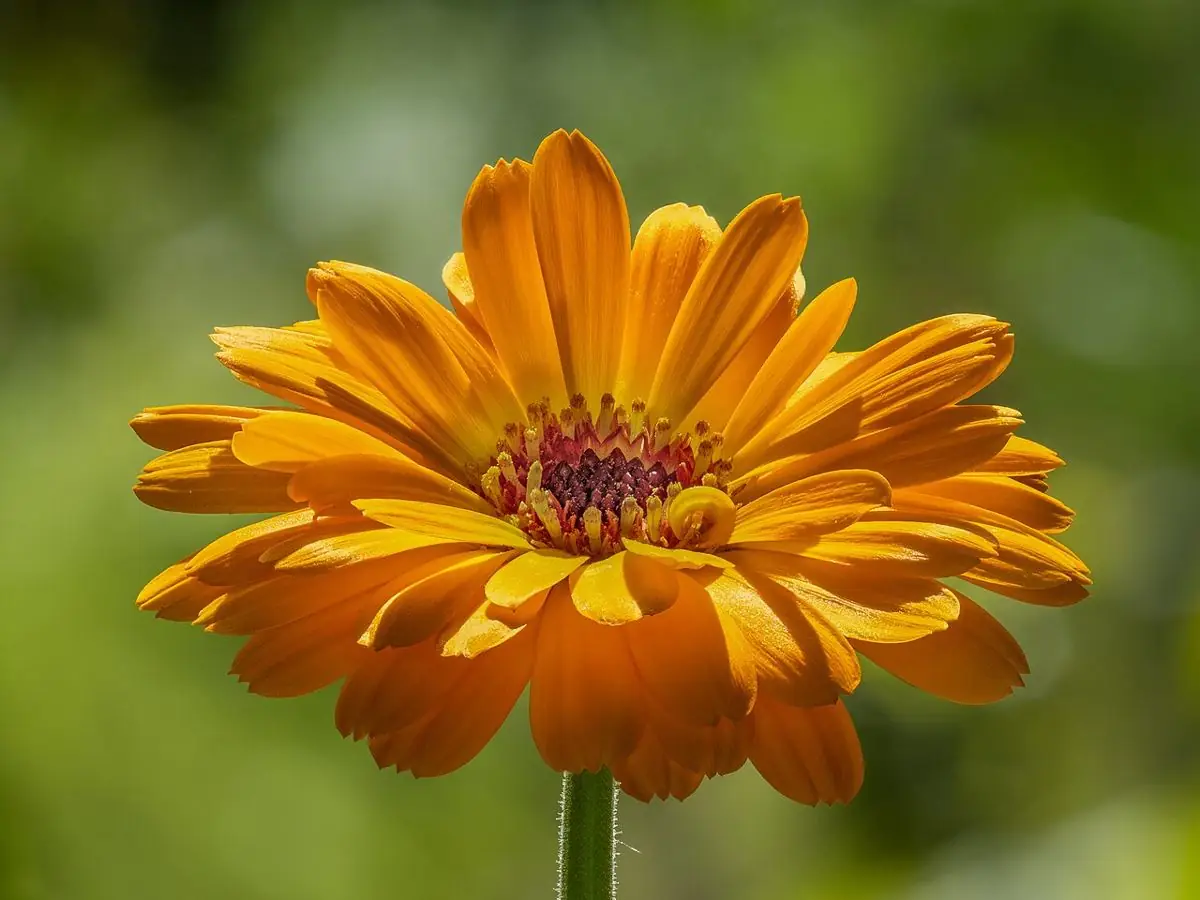
Calendula’s cheerful gold-and-orange heads open with the sun and close at dusk, and the plant keeps producing new flowers right up until frost, which is part of why it has stayed a kitchen-garden fixture for so long. The petals are edible and were once used to color butter and broth. Infused into oil and worked into a salve, calendula is the herb most often kept on hand in the medicine drawer for everyday dry skin and minor household nicks.
Traditional profile
Actions
- vulneraryHelps wounds heal.
- anti-inflammatoryUsed to calm swelling, redness, and heat in tissues.
- astringentTightens and dries tissue; the puckery feel of strong tea, from tannins.
- emollientSoftens and soothes the skin.
Body systems
Culpeper (1653)
- Ruling planet
- Sun, under Leo
How to know it
A bushy annual a foot or two tall with soft, slightly sticky, spoon-shaped leaves and a resinous smell. The flowers are two to three inches across in shades from pale yellow to deep orange, single or double. The seeds are unusual: curled, ridged, and hooked, like little claws.
Don’t confuse it with the French and African marigolds (Tagetes) sold as bedding plants. Those have finely divided, strong-smelling leaves and are a different plant altogether; when an old recipe says “marigold petals,” it means calendula.
History & lore
Calendula comes from the Latin calendae, the first day of the month, from the old belief that it flowers in every month of the year; the Italian name fiore d’ogni mese means “flower of every month.” The English “marigold” later became tied to the Virgin Mary.
Culpeper called it “an herb of the Sun, and under Leo.” An old account quoted by Grieve says the dried petals were kept “throughout Dutchland against winter to put into broths,” so many that grocers kept whole barrels of them. The flowers were also boiled for a yellow dye and used to color cheese and butter.
Growing it
Sow the seed straight into the garden in spring, or in autumn where winters are mild. It is not fussy about soil and wants sun. Calendula likes cool weather best and may sulk in the worst of summer heat, then come back strong in the fall.
Picking is what keeps it blooming: every flower left to set seed tells the plant it is finished. Let a few go at the end of the season and it will seed itself.
Varieties & companions
For salves, choose deep orange, resin-rich kinds such as ‘Resina’ or the German medicinal strain ‘Erfurter Orangefarbige.’ ‘Pacific Beauty’ and ‘Indian Prince’ are showier garden mixes that still work well for petals.
Calendula is a classic companion for tomatoes and brassicas. It draws pollinators and hoverflies, and it tends to attract aphids to itself, so it is sometimes planted as a sacrificial “trap” plant at the edge of a bed.
Gathering & drying
Pick the heads when they are fully open, around midday on a dry day, when your fingers come away sticky with resin. That resin is what you are after for oils and salves. Pick every two or three days.
Dry the whole heads face-down on a screen in the shade. Their thick green centers hold moisture, so give them a good two weeks and make sure they are brittle before jarring them, or they can mold. For cooking, pull the petals and dry them separately; they dry in a few days.
At the hearth
Calendula oil and the salve made from it are the herb’s main household use: a tin kept by the sink for chapped hands and rough winter skin. The petals were also once used as a yellow dye for cloth, cheese, and butter.
In the kitchen
Fresh petals scattered over a salad add color and a faint peppery taste. Dried petals simmered in rice or broth tint it gold, which earned calendula the old name “poor man’s saffron,” though the flavor is much milder.
Traditional usage
The flower heads and petals are the parts used. Most household use was on the skin: infused oil, salves, and washes for chapped hands, scrapes, and small burns. A tea of the petals was used as a gargle for a sore mouth or throat.
In the kitchen, dried petals went into broths and stews for color and a little flavor. Accounts from the American Civil War and the First World War describe calendula being used on wounds in the field, though how widely is hard to know.
Chemical constituents
The flowers are rich in triterpenoids. The best studied are faradiol esters (such as faradiol-3-myristate and -palmitate), which lab work links to the plant’s soothing effect on skin, along with triterpene saponins built on oleanolic acid.
The orange color comes from carotenoids, including lutein and β-carotene, and orange varieties carry more than yellow ones. There are also flavonoids (quercetin and isorhamnetin glycosides), polysaccharides, and a small amount of essential oil. The sticky resin you feel when picking holds much of the triterpenoid content.
What the research says
The best-known trials involve skin damage from radiation therapy. A 2004 French trial of about 250 women with breast cancer found fewer moderate-to-severe skin reactions with calendula ointment than with trolamine cream. A larger 2013 Swedish trial of about 400 women found no difference between calendula cream and a plain aqueous cream. A 2015 review called calendula safe on the skin but the evidence for it “weak.”
European regulators list calendula flower as a traditional herbal medicine for minor skin inflammation such as sunburn, small wounds, and mouth or throat irritation. They noted that clinical trials were insufficient but long use supported it.
Skin allergy is the main reported side effect, most often in people allergic to daisy-family plants.
Good to know
Like chamomile, calendula belongs to the daisy family, and people sensitive to ragweed and its relatives may react to it.
Further reading
- European Medicines Agency: Calendula flower herbal summaryWhat European regulators accept as traditional use, and why.
- Pommier et al., Journal of Clinical Oncology (2004)Calendula vs trolamine during breast radiotherapy.
- Sharp et al., European Journal of Oncology Nursing (2013)Calendula vs aqueous cream: no difference.
- Kodiyan & Amber, Antioxidants (2015): review of topical calendula in radiotherapyOpen-access review of the trials.
- Mrs. M. Grieve, A Modern Herbal (1931): MarigoldNames, broths, and dyes.
- Nicholas Culpeper, The Complete Herbal (1653)Free public-domain copy at Project Gutenberg.