Turmeric
Curcuma longa
The golden root of Indian kitchens, wedding pastes, and household first aid.
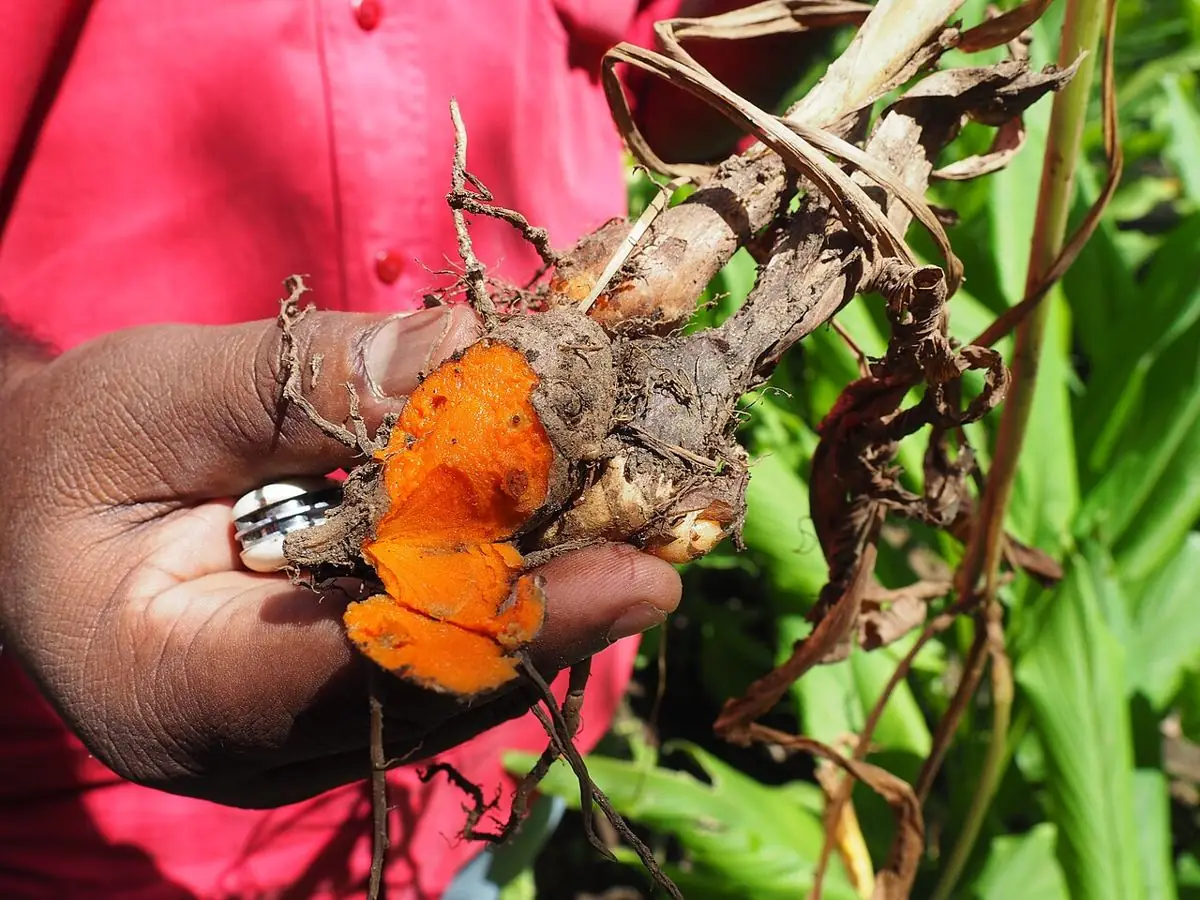
Turmeric is a ginger relative whose bright orange rhizome is boiled, dried, and ground into the yellow powder that colors curries, rice, and mustard. In India it is also a household antiseptic, a skin paste for brides before their weddings, and one of the most important herbs in Ayurveda. Today it is one of the most-studied plants in the world.
Traditional profile
Actions
- anti-inflammatoryUsed to calm swelling, redness, and heat in tissues.
- carminativeEases gas, bloating, and colic.
- vulneraryHelps wounds heal.
- antimicrobialActs against bacteria, fungi, or other microbes, at least in the lab.
- cholagogueEncourages the flow of bile.
Body systems
Chinese medicine
- Name
- 姜黄 Jiāng huáng
- Nature
- Warm
- Flavor
- Acrid, bitter
- Channels
- Spleen, Liver
- Five phases
- Metal, Fire by flavor
Ayurveda
- Name
- Haridra
- Taste
- Pungent, bitter
- Potency
- Heating
- After digestion
- Pungent
- Doshas
- Reduces Kapha and Pitta
How to know it
A leafy tropical plant three feet tall with large, oblong, bright green leaves on long stalks, and occasionally a cone of pale green and pink bracts. The rhizome is finger-like and branching, with thin brown skin and vivid orange flesh that stains everything it touches.
History & lore
Turmeric has been grown in India for thousands of years, and India still produces most of the world’s crop. In Sanskrit it has dozens of names, among them haridra, “the yellow one.” Before a Hindu wedding, family and friends smear the couple with a paste of turmeric in the haldi ceremony, a custom of blessing and beautifying.
Marco Polo is said to have compared it to saffron in the 1200s, and in medieval Europe it was known as “Indian saffron.” Turmeric is also a traditional dye, giving a golden color to cloth and to some Buddhist robes.
Growing it
Plant fresh rhizome pieces with buds in spring in rich, moist, well-drained soil in bright shade or morning sun. It needs heat, humidity, and a long season of eight to ten months, so in Arizona grow it in a large pot you can keep watered and bring in before frost.
Varieties & companions
Indian varieties such as ‘Alleppey’ (high in curcumin) and ‘Madras’ are traded by region. White turmeric or zedoary (C. zedoaria) and black turmeric (C. caesia) are relatives. Grow it with ginger and cardamom.
Gathering & drying
Dig the rhizomes when the leaves die back. Use them fresh, or boil them for about an hour, dry them in the sun until hard, and grind them. Boiling is traditional and helps even out the color.
At the hearth
Warm turmeric milk (haldi doodh) is the classic Indian bedtime drink for a cough or aches. A paste of turmeric and water or oil is dabbed on small cuts and scrapes, and turmeric with gram flour and yogurt is an old face mask.
In the kitchen
Add ground turmeric to hot oil at the start of a curry or dal so its flavor opens up. Use fresh turmeric grated like ginger in pickles, juices, and rice. A pinch of black pepper and a little fat help the body absorb its main compound.
Traditional usage
Rhizome as spice, paste, milk, and powder. In Ayurveda it is used for skin disease, wounds, diabetes, cough and colds, anemia, and allergies. In Chinese medicine the related jiāng huáng is used to move blood and relieve pain in the shoulders and for menstrual pain.
Walker and Bauer’s The Ancient Art of Life and Death (2002) records jiāng huáng as the first ingredient of an old external ointment for swelling and pain, ground with dried ginger, gardenia, myrrh, and frankincense and applied over bruises.
Ayurveda (haridra): pungent and bitter taste, heating potency, pungent post-digestive effect; reduces Kapha and Pitta. Chinese medicine: acrid and bitter, warm, entering the Spleen and Liver channels.
Chemical constituents
The color comes from curcuminoids (curcumin, demethoxycurcumin, and bisdemethoxycurcumin), which make up a few percent of the dried root. The aroma comes from turmerones, especially ar-turmerone. Curcumin is poorly absorbed; piperine from black pepper greatly increases how much reaches the blood, which is one reason Indian recipes pair them.
What the research says
NCCIH says early research on turmeric for knee osteoarthritis is positive but higher-quality studies are needed, and that it may help some measures of fatty liver disease and mouth sores from cancer treatment. It cannot yet say turmeric works for any condition. European regulators list it as a traditional herbal medicine for mild digestive problems such as fullness and gas.
Turmeric in food is safe. Regular supplements are likely safe for two or three months, but liver injury has been reported, especially with high-absorption products. Stop and see a doctor if you notice fatigue, nausea, dark urine, or yellow skin. Avoid supplements in pregnancy, and ask a doctor if you have gallstones or take blood thinners.
Good to know
Turmeric stains counters, fingers, and plastic; clean up quickly with dish soap, and sunlight fades stains on cloth.
Further reading
- NCCIH: TurmericResearch and safety summary, updated 2025.
- European Medicines Agency: Turmeric herbal summaryWhat European regulators accept, and on what evidence.
- The Ayurvedic Pharmacopoeia of India, Part I, Vol. 1Government of India monographs: taste, potency, and actions.
- Me & Qi: Jiang Huang (turmeric)Chinese medicine properties.