Shiso (Perilla)
Perilla frutescens
The ruffled green and purple leaf that colors umeboshi and wraps Korean barbecue.
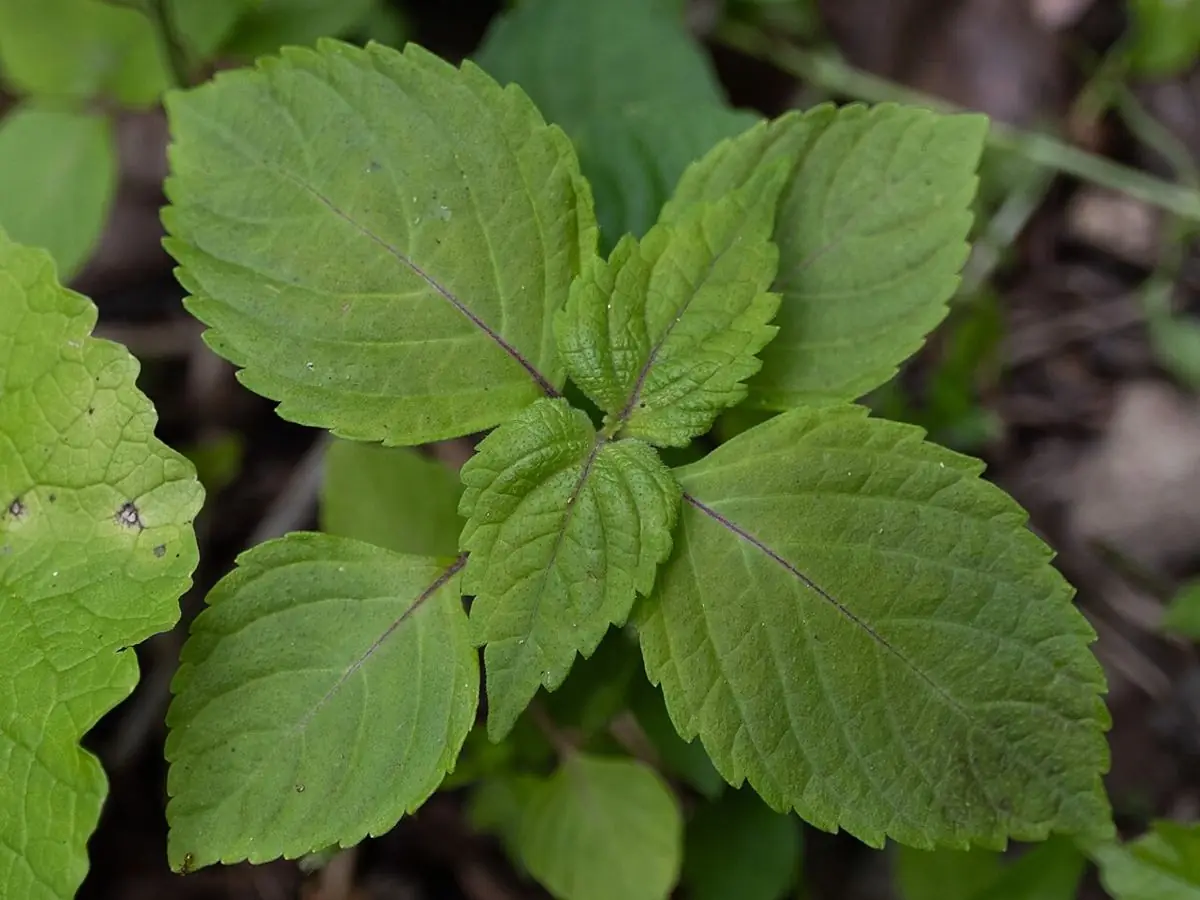
Perilla is a mint-family annual grown across East Asia. Japanese cooks call it shiso and use the green leaf with sashimi and the purple leaf to dye pickled plums red; Korean cooks grow a larger-leaved type, kkaennip, for wraps and pickles, and press its seeds for oil. In Chinese medicine the leaf is a warming herb for early colds and stomach upsets.
Traditional profile
Actions
- diaphoreticBrings on a sweat; used at the start of a cold or fever.
- carminativeEases gas, bloating, and colic.
- aromaticRich in fragrant oils, which tend to settle the stomach and clear the head.
- antiemeticSettles nausea and vomiting.
Body systems
Chinese medicine
- Name
- 紫苏叶 Zǐ sū yè
- Nature
- Warm
- Flavor
- Acrid, aromatic
- Channels
- Lung, Spleen
- Five phases
- Metal by flavor
How to know it
A bushy annual two to four feet tall with square stems and broad, toothed, often ruffled leaves in opposite pairs, green, purple, or two-toned. Small white to purple flowers form spikes in late summer. The smell is distinctive: something between mint, basil, cumin, and citrus.
History & lore
Shiso arrived in Japan by the 700s or 800s. Red shiso (akajiso) is packed with salted ume plums to turn them red as umeboshi, and the dried, salted leaves become the rice seasoning yukari. Green shiso (ōba) became a common garnish after it was grown commercially in the 1960s.
In Korea the related deulkkae plant is grown for its big leaves and for perilla seeds, whose toasted oil (deulgireum) is a staple. Chinese medicine uses the leaf (zǐ sū yè) for colds with chills and nausea, and traditionally with seafood meals, to settle the stomach.
Growing it
Sow in warm soil after frost, in sun or light shade, and keep it watered. Pinch the tips for more leaves. It self-seeds heavily; cut off flower spikes if you don’t want it everywhere next year.
Varieties & companions
Green shiso, red shiso, and bicolor ‘Britton’ are Japanese types; Korean perilla has larger, flatter leaves. Grow it beside basil and cilantro in the kitchen garden.
Gathering & drying
Pick leaves as needed through summer; they are best fresh. Red leaves can be dried and ground. Seeds ripen in fall and can be pressed or toasted.
At the hearth
A tea of the leaves with a slice of ginger is an East Asian household drink for the start of a cold, and the leaves were chewed to settle a queasy stomach.
In the kitchen
Serve green shiso with sashimi and sushi, slice it into noodles and salads, or fry it as tempura. Use red shiso for pickled plums, pink shiso juice, and yukari. Wrap grilled meat in Korean perilla leaves, or pickle them in soy sauce.
Traditional usage
Leaves as seasoning, tea, and pickle color; seeds for oil and as a separate herb for cough. In Chinese medicine the leaf is used for colds with chills, nausea, and bloating, and for food poisoning from fish or crab.
Chinese medicine: acrid and aromatic, warm, entering the Lung and Spleen channels.
Chemical constituents
Shiso’s flavor comes mostly from perillaldehyde, which is found in much lower amounts in other perillas. The red color is an anthocyanin called shisonin. The leaves are rich in rosmarinic acid and luteolin, and the seed oil is one of the richest plant sources of α-linolenic acid, an omega-3 fat.
What the research says
A few small Japanese trials tested perilla leaf extract high in rosmarinic acid for seasonal allergy symptoms, with some improvement, but the research is limited.
Shiso as food is safe. Some wild perillas contain perilla ketone, which is poisonous to cattle and horses that graze it; livestock owners call it “perilla mint” and remove it from pastures.
Good to know
Perilla has escaped gardens in the eastern U.S. and is considered invasive in some states; deadhead it to keep it from spreading.
Further reading
- Me & Qi: Zi Su Ye (perilla leaf)Chinese medicine properties and uses.
- Wikipedia: Perilla frutescens var. crispaShiso history, uses, and chemistry.