Jujube
Ziziphus jujuba
The Chinese red date: crisp as an apple when fresh, sweet as a date when dried.
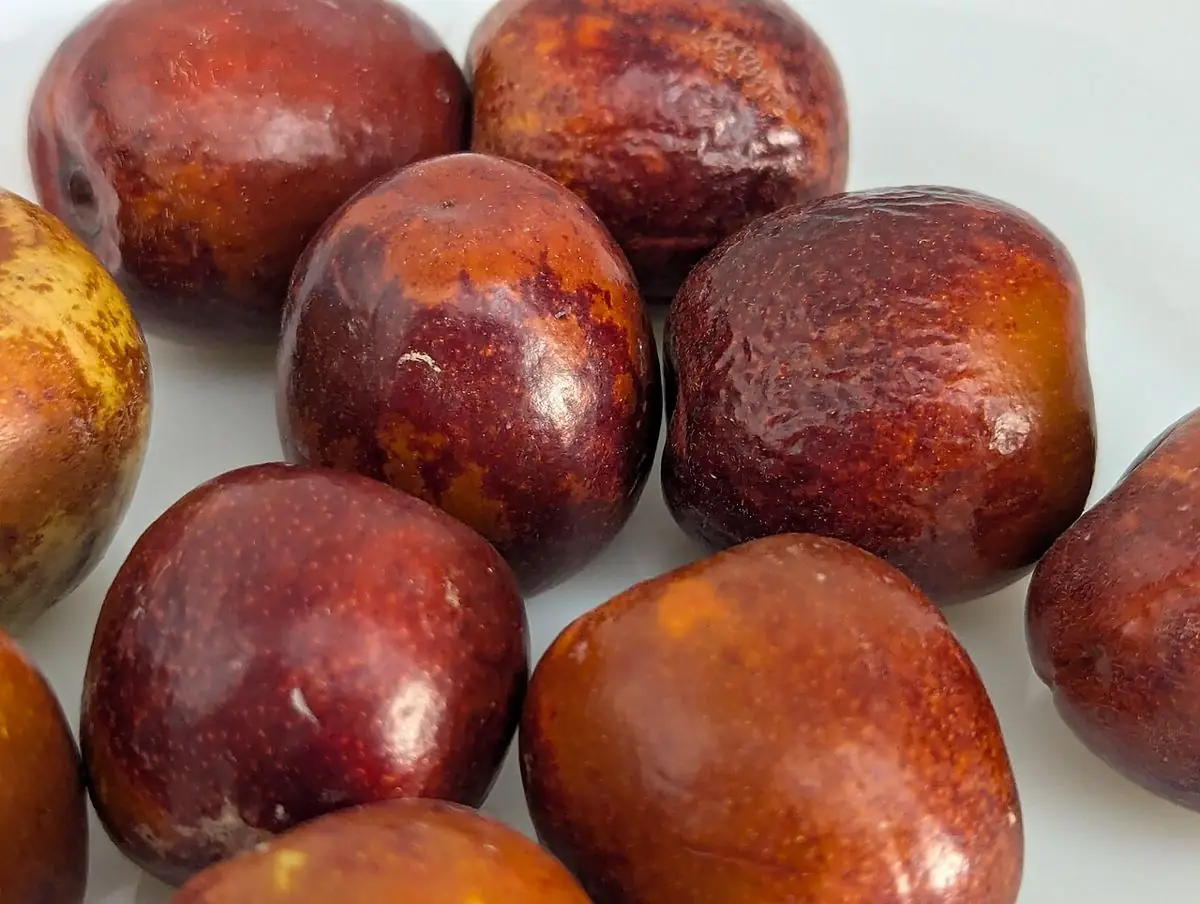
Jujube trees have been grown in China for thousands of years, and the dried red fruit is one of the most common ingredients in Chinese and Korean cooking and medicine. It is added to teas and soups to sweeten and soften them, and in Chinese medicine it “harmonizes” formulas and calms the spirit. Jujubes also thrive in the hot, dry summers of the Southwest.
Traditional profile
Actions
- nutritiveA food-like herb, rich in vitamins or minerals.
- tonicStrengthens and restores when taken over time.
- nervineActs on the nerves: relaxing nervines calm, tonic nervines restore.
Body systems
Chinese medicine
- Name
- 大枣 Dà zǎo
- Nature
- Warm
- Flavor
- Sweet
- Channels
- Spleen, Stomach, Heart
- Five phases
- Earth by flavor
How to know it
A small tree with zigzag branches, often with paired spines, and glossy oval leaves with three prominent veins. Tiny greenish-yellow flowers in early summer become oval fruits that turn from green to mottled mahogany as they ripen. Fresh ripe fruit is crisp and apple-like; left on the tree it wrinkles and sweetens like a date.
History & lore
Jujube (dà zǎo) is listed in the Shennong Bencao Jing and appears in a huge share of classical Chinese formulas, often paired with fresh ginger. In Korea, red dates (daechu) go into ginseng chicken soup (samgyetang) and into sweet rice dishes, and at traditional wedding ceremonies the couple’s parents toss dates and chestnuts for the bride to catch in her skirt, a wish for children.
The sour seeds of a wild variety are a separate herb, suān zǎo rén, used in China for restless sleep.
Growing it
Jujubes love heat and tolerate drought, alkaline soil, and wind, which makes them one of the best fruit trees for southern Arizona. Plant grafted trees in full sun. They leaf out late in spring and fruit reliably in hot summers.
Varieties & companions
‘Li’ has large, round fruit good fresh; ‘Lang’ is pear-shaped and best dried; ‘Sugar Cane’ and ‘Honey Jar’ are small and very sweet. Most varieties set fruit alone, but two varieties crop better.
Grow jujube with goji, pomegranate, and fig for a heat-loving fruit corner.
Gathering & drying
Pick fresh-eating fruit when it is half to fully brown and crisp. For drying, leave it on the tree until fully red and starting to wrinkle, then finish drying in the sun or a dehydrator.
At the hearth
A few dates simmered with ginger make a warming winter tea, and jujube tea is drunk in Korea for tiredness and sleeplessness.
In the kitchen
Eat fresh jujubes like apples. Dried ones sweeten soups, congee, braises, and sticky rice, and are cooked into jujube paste for mooncakes and steamed buns. Candied jujubes are a traditional sweet.
Traditional usage
Fruit as food, tea, and in herbal formulas; seeds of the sour jujube as a separate herb for sleep. In Chinese medicine jujube is used for tiredness, poor appetite, and loose stools and to calm restlessness, and it tempers harsher herbs in a formula.
Walker and Bauer’s The Ancient Art of Life and Death (2002) records the old custom of brewing tonic decoctions such as the Eight Treasure decoction (bā zhēn tāng) and Restore the Spleen decoction (guī pí tāng) with one jujube and a slice of fresh ginger. The sour jujube seed is itself one of the ingredients of guī pí tāng.
Chinese medicine: sweet, warm, entering the Spleen, Stomach, and Heart channels; a qi tonic.
Chemical constituents
Dried jujubes are mostly sugars, with fiber and pectin. Fresh fruit is very high in vitamin C. Jujubes also contain an unusually large amount of cyclic AMP, a signaling molecule, plus triterpenic acids (betulinic, oleanolic, and ursolic acids), flavonoids, and saponins called jujubosides, which are concentrated in the seeds.
What the research says
Human research is limited to a few small trials, including some on constipation and on jujube seed extracts for sleep, with encouraging but preliminary results. Most studies are in the lab.
Jujubes as food are safe. Their sweetness adds up in dried form, and the hard pits can break teeth or choke small children.
Good to know
Jujube trees sucker from the roots; grafted trees keep the fruit you chose, while suckers from the rootstock bear small, thorny, sour fruit.
Further reading
- Me & Qi: Da Zao (jujube)Chinese medicine properties and uses.
- Wikipedia: JujubeHistory, varieties, and culinary uses.