Goji
Lycium barbarum
Small scarlet berries from Ningxia, simmered into soups and teas in Chinese kitchens.
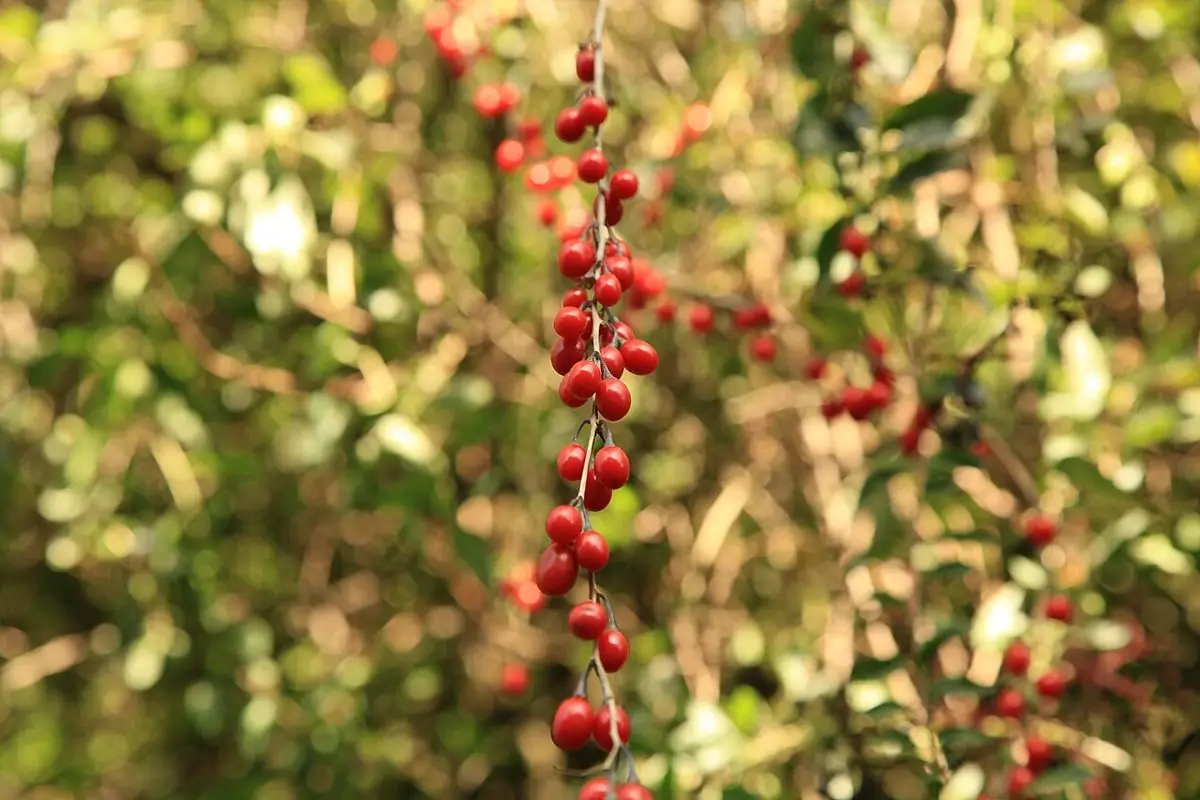
Goji, or wolfberry, is a thorny shrub whose bright red berries have been eaten and used as medicine in China for two thousand years. The most famous come from Ningxia in the northwest, where they are dried in the sun by the ton. In Chinese kitchens they go into soups, congee, and tea; in Chinese medicine they nourish the Liver and Kidneys and brighten the eyes.
Traditional profile
Actions
- nutritiveA food-like herb, rich in vitamins or minerals.
- antioxidantRich in compounds that protect cells from oxidative damage.
- tonicStrengthens and restores when taken over time.
Body systems
Chinese medicine
- Name
- 枸杞子 Gǒu qǐ zǐ
- Nature
- Neutral
- Flavor
- Sweet
- Channels
- Liver, Kidney, Lung
- Five phases
- Earth by flavor
How to know it
A sprawling, arching shrub with gray, sometimes thorny stems, small narrow leaves in clusters, and small purple, trumpet-shaped flowers. The berries are oblong, about half an inch long, glossy orange-red, and hang singly along the stems.
Lycium chinense is a close relative used the same way. The Southwest has its own native wolfberries (such as L. andersonii and L. pallidum), whose red berries were eaten by the O’odham, Apache, and other desert peoples.
History & lore
Goji berries (gǒu qǐ zǐ) appear in the Shennong Bencao Jing, and the root bark is a separate herb, dì gǔ pí. Stories tell of villagers who lived long lives because goji roots grew into their wells.
Zhongning County in Ningxia is known as the home of goji, and dried berries from there are prized across China. Goji became a Western “superfood” in the 2000s, often with exaggerated health claims.
Growing it
Very hardy and drought tolerant once established; it grows well in the dry, sunny, alkaline soils of the Southwest. Plant in full sun and prune to keep the long canes under control. It fruits on new growth from its second or third year.
Varieties & companions
Named varieties include ‘Big Lifeberry,’ ‘Sweet Lifeberry,’ and ‘Crimson Star.’ Grow it with tea chrysanthemum and jujube for a small Chinese tea garden, or along a fence where the canes can lean.
Gathering & drying
Pick berries when fully red and soft; touching them with bare hands can blacken them, so many growers shake them onto a sheet. Dry in shade until leathery but still pliable, like raisins.
At the hearth
A small handful of dried berries in hot water, alone or with chrysanthemum, is a common daily tea for tired eyes in China.
In the kitchen
Add dried goji to chicken soup, congee, and braises for the last 10 or 15 minutes, or soak them and eat them like raisins in oatmeal and trail mix. The young leaves are cooked as a green in southern China.
Traditional usage
Berries as food, tea, and wine; root bark as a separate cooling herb. In Chinese medicine the berries are used for weak vision, dizziness, dry cough, and fatigue in older people.
Martial arts herbalists counted goji among the kidney-strengthening ingredients of bǔ shèn huó xuè tāng, a decoction for rebuilding sinew and bone after injury, according to Walker and Bauer’s The Ancient Art of Life and Death (2002).
Chinese medicine: sweet, neutral, entering the Liver, Kidney, and Lung channels; a yin tonic.
Chemical constituents
Goji is known for Lycium barbarum polysaccharides (LBPs), a group of complex sugars studied for immune and antioxidant effects. The berries are very rich in zeaxanthin (mostly as zeaxanthin dipalmitate), a yellow pigment concentrated in the eye’s macula, and also contain betaine, vitamin C, and other carotenoids.
What the research says
Small trials suggest that eating goji raises blood zeaxanthin levels, and some have looked at eye health in older adults, but the evidence is early. Many other claims made for goji have not held up to study.
Several case reports describe goji raising the effect of the blood thinner warfarin, so people on warfarin should avoid it or check with their doctor. Goji is in the nightshade family, and a few people are allergic to it.
Good to know
Buy organic or trusted brands; imported dried goji has sometimes been found with pesticide residues.
Further reading
- Me & Qi: Gou Qi Zi (goji berry)Chinese medicine properties: nature, flavor, channels.
- Rivera et al., Pharmacotherapy (2012): goji and warfarinCase report of a likely interaction.