San Qi (Tienchi Ginseng)
Panax notoginseng
The “worth more than gold” root of Yunnan, the classic Chinese herb for bleeding and bruises.
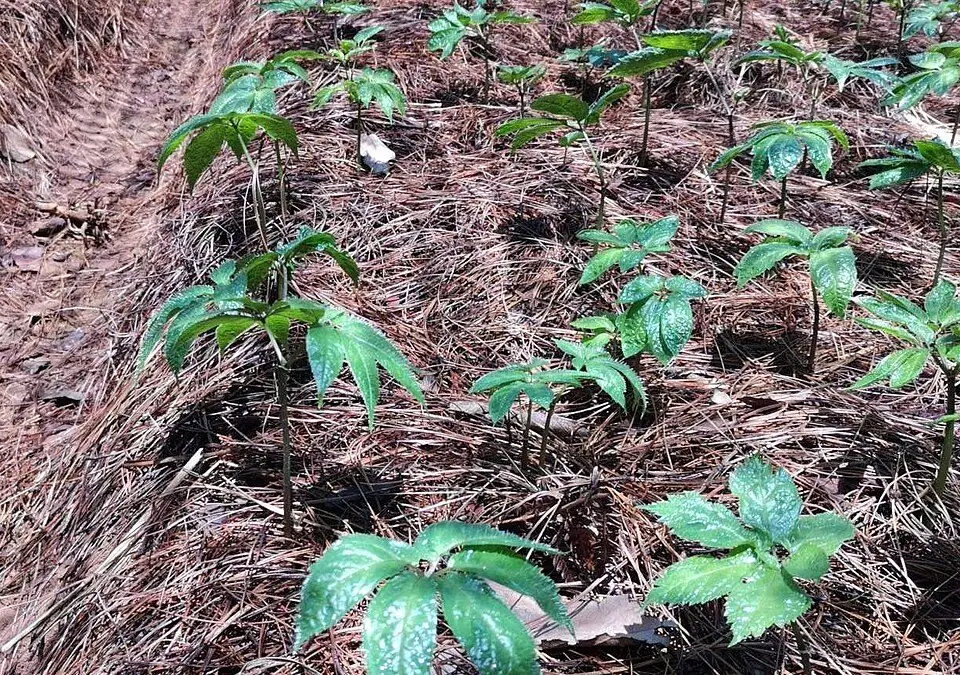
San qi is a shade-loving relative of ginseng grown on the mountainsides of Yunnan. Its hard, knobby roots have been the first thing a Chinese herbalist reaches for with cuts, bruises, and bleeding for centuries, and it is the leading herb in many martial-arts bruise liniments. Chinese nicknames call it “not to be traded for gold.”
Traditional profile
Actions
- vulneraryHelps wounds heal.
- analgesicEases pain.
- anti-inflammatoryUsed to calm swelling, redness, and heat in tissues.
- astringentTightens and dries tissue; the puckery feel of strong tea, from tannins.
Body systems
Chinese medicine
- Name
- 三七 Sān qī
- Nature
- Warm
- Flavor
- Sweet, slightly bitter
- Channels
- Liver, Stomach
- Five phases
- Earth, Fire by flavor
How to know it
A low perennial one to two feet tall. Each stem carries a whorl of about three compound leaves, each divided into five to seven toothed leaflets, and a single cluster of small greenish flowers that ripens into bright red berries.
The dried root is small, knobby, and gray-brown, and so hard that traders describe it as “bronze skin and iron bones.” Broken, it is gray-green to brownish inside and tastes bitter first, then slightly sweet.
History & lore
Two stories explain the name “three-seven”: the three leaf stalks with seven leaflets each, or the three to seven years the plant was once grown before harvest. Li Shizhen’s 1578 Bencao Gangmu praised it for wounds and bleeding, and it was also called jīn bù huàn, “not to be traded for gold.”
Wenshan in southeastern Yunnan is known as the home of san qi and grows most of the world’s crop. The famous wound powder Yunnan Baiyao, created in 1902, keeps its full recipe secret, but san qi is widely recognized as its key ingredient.
Growing it
San qi grows only under heavy shade, and in China it is raised under black shade cloth on terraces 4,000 to 6,000 feet up. It needs mild temperatures, humid air, and rich, well-drained soil, and it is slow and fussy. It is not a practical plant for a desert garden.
Varieties & companions
It is a close cousin of Asian ginseng (Panax ginseng) and American ginseng (P. quinquefolius), and shares many of their saponins, but it is used quite differently. Spring-harvested roots, dug before the plant flowers, are valued over winter roots dug after the berries ripen.
In formulas it is paired with safflower, myrrh, and frankincense for bruises and pain.
Gathering & drying
Roots are dug from third-year plants in autumn, washed, sun-dried, and rubbed or tumbled until they are smooth and dark. The flowers and leaves are harvested too and sold as teas in Yunnan.
At the hearth
Households in southern China kept a small jar of san qi powder or a bottle of Yunnan Baiyao in the medicine cabinet for cuts and nosebleeds, the way Western ones keep a styptic pencil.
In the kitchen
In Yunnan a few slices of the root are simmered with chicken into a slightly bitter restorative soup, especially for women after childbirth, and the dried flowers are steeped as a cooling tea.
Traditional usage
Root as powder, pills, soup, and liniment; flowers as tea. Chinese medicine prizes san qi because it is said both to stop bleeding and to clear the stagnant blood of a bruise, where most herbs do one or the other. Powder was taken with water or sprinkled on wounds, and the root soaked in alcohol for bruises and sprains.
In the dit da jow bruise liniment described in Walker and Bauer’s The Ancient Art of Life and Death (2002), san qi is the monarch, the leading herb of the formula, and it is also one of the core herbs in their internal trauma formulas.
Chinese medicine: sweet and slightly bitter, warm, entering the Liver and Stomach channels.
Chemical constituents
The root is rich in saponins, including notoginsenoside R1 and the ginsenosides Rg1 and Rb1, which it shares with other ginsengs. It also contains dencichine, an unusual amino acid studied for its effect on blood clotting, along with flavonoids and polysaccharides.
What the research says
San qi has been studied mostly in China, including extracts used in hospitals for stroke and heart disease. Reviews describe effects on blood clotting and circulation in laboratory and small clinical studies, but large, high-quality trials outside China are scarce.
San qi is avoided in pregnancy. It may interact with blood thinners and other medicines that affect clotting, and serious bleeding always needs medical care, not a home remedy.
Good to know
Yunnan Baiyao is not pure san qi. Its full recipe is a state secret, and in 2014 its maker acknowledged that it contains a small amount of processed aconite, a toxic herb, so it should be used only as the label directs.
Further reading
- Me & Qi: San Qi (notoginseng root)Chinese medicine properties and uses.
- Wang et al., “Traditional uses, botany, phytochemistry, pharmacology and toxicology of Panax notoginseng” (2016)A scientific review in the Journal of Ethnopharmacology.
- A narrative review of Panax notoginseng saponinsRecent review of its chemistry and studies (free full text).