Rosemary
Salvia rosmarinus
“Rosemary for remembrance” — the one herb on this list that never fully dies back by the hearth.
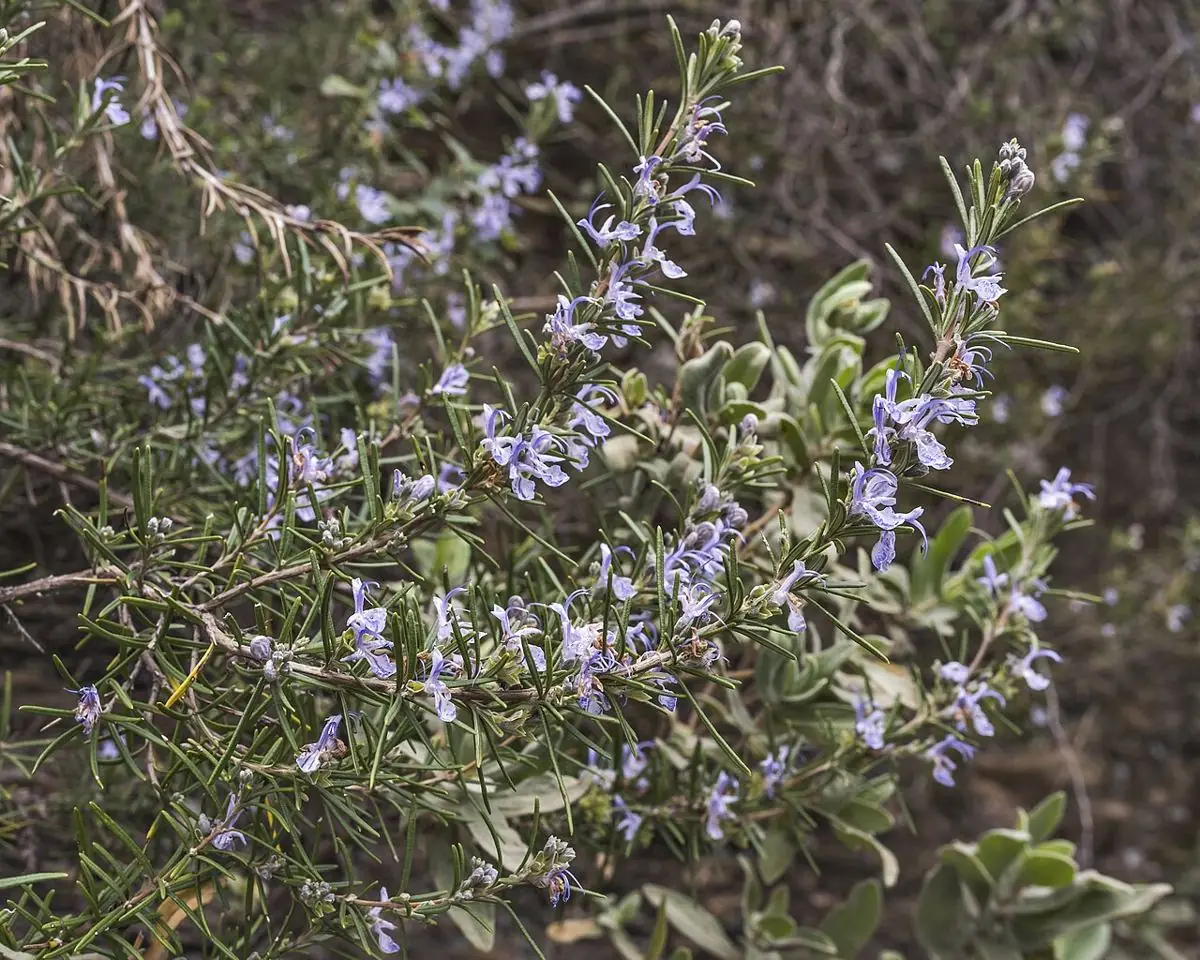
Where winters allow it to stay outdoors, rosemary is evergreen, which is exactly why it earned a place by the kitchen door and the hearth long before refrigeration made year-round herbs unremarkable. Its resinous needles flavor roasts and breads, and a strong cooled infusion has been used as a traditional dark-hair rinse for generations. Its old association with memory and fidelity made it a fixture at both weddings and funerals in earlier centuries.
Traditional profile
Actions
- stimulantQuickens and warms the circulation or digestion.
- carminativeEases gas, bloating, and colic.
- antioxidantRich in compounds that protect cells from oxidative damage.
- aromaticRich in fragrant oils, which tend to settle the stomach and clear the head.
Body systems
Culpeper (1653)
- Ruling planet
- Sun, under the Ram (Aries)
How to know it
An evergreen shrub, from a low sprawling mat to an upright bush five feet or more, with woody stems and narrow, leathery, needle-like leaves — dark green on top, pale and felted underneath. Small two-lipped flowers, pale blue to deep violet, appear along the stems in late winter and spring and sometimes again in autumn. The smell is resinous, like pine and camphor.
Botanists moved rosemary into the sage genus in 2017, so you’ll see both Rosmarinus officinalis and Salvia rosmarinus; they are the same plant.
History & lore
The name comes from the Latin ros marinus, “dew of the sea,” for the shrub’s habit of growing on sea cliffs around the Mediterranean. In Spain it is called romero, the pilgrim’s flower, from a legend that it sheltered the Virgin Mary on the flight into Egypt and that its white flowers turned blue where she spread her cloak to dry.
Rosemary stood for memory and faithfulness. Brides wore it and gave gilded sprigs to guests, and mourners threw it into graves; Ophelia says in Hamlet, “There’s rosemary, that’s for remembrance.” In Australia and New Zealand people still wear a sprig on Anzac Day, because rosemary grows wild at Gallipoli.
Hungary water, a rosemary-scented spirit, was said to have been made for a Queen of Hungary who was cured of paralysis by it, a story that is almost certainly legend. Rosemary was burned in sickrooms, and French hospitals burned it with juniper berries to freshen the air.
Growing it
Rosemary is a Mediterranean hillside plant: full sun, sharp drainage, and not much water once it is settled in. Heavy, wet soil is its main enemy. Most kinds survive winters down to the high teens or low twenties Fahrenheit; hardier varieties such as ‘Arp’ take a little more cold with some shelter.
In colder places, grow it in a pot and bring it into a bright, cool window for winter, watering sparingly. Trim it after flowering to keep it bushy.
Varieties & companions
‘Arp’ and ‘Madeline Hill’ (sold as ‘Hill Hardy’) are the most cold-tolerant. ‘Tuscan Blue’ and ‘Blue Spires’ are tall and upright; ‘Barbecue’ has straight stems that make good skewers; ‘Prostratus’ trails over walls and pots; and ‘Majorca Pink’ has pink flowers.
It belongs with lavender, sage, thyme, and oregano in a sunny, dry bed. Old gardening advice plants it near carrots, beans, and cabbages to confuse pests with its scent. The evidence for that is thin, but its early flowers are a real help to bees.
Gathering & drying
Snip sprigs whenever you need them, all year, taking no more than about a third of the plant at once. For drying, cut longer stems before or just as it flowers and hang them in bundles; once dry, strip the needles off with your fingers and keep them whole.
At the hearth
A strong, cooled infusion is the traditional rinse for dark hair. Sprigs went into moth sachets and wreaths, were burned to freshen sickrooms and kitchens, and were carried at weddings and laid on coffins as a token of remembrance.
In the kitchen
Rosemary goes with roast lamb, chicken, pork, and potatoes, into focaccia and other breads, and into olive oil, salt, and vinegar. Chop the needles finely or use whole sprigs you can lift out; the flavor is strong, so a little goes far.
Traditional usage
The leaves and flowering tops are the parts used. A strong infusion, a tablespoon of leaves per cup steeped fifteen minutes, was a traditional rinse for dark hair and a scalp wash. Weaker, it was drunk as a tea for poor digestion and headaches.
Rosemary oil and infused oil were rubbed into sore muscles and joints, and sprigs were packed with linens and woolens against moths. Rosemary is still one of the most common herbs in European and Mediterranean cooking.
Chemical constituents
Rosemary’s essential oil is mostly 1,8-cineole, camphor, and α-pinene, with borneol and bornyl acetate. The balance varies so much that growers recognize different chemotypes, such as cineole-rich, camphor-rich, and verbenone types.
The leaves also hold carnosic acid and carnosol, strong antioxidants that make rosemary extract a common natural preservative in foods (it is approved in the EU as additive E392). Rosmarinic acid, found in many mint-family herbs, was first isolated from rosemary and named for it. The leaves also contain ursolic and oleanolic acids and flavonoids.
What the research says
Two small studies get quoted often. In 2012, researchers exposed 20 people to rosemary oil aroma and found that higher blood levels of 1,8-cineole went with better speed and accuracy on mental tasks, though the study didn’t show cause and effect. In 2015, a trial of about 100 people with pattern hair loss found that rosemary oil and 2% minoxidil both increased hair counts after six months, with no significant difference between them. Neither study has been confirmed by large trials.
European regulators list rosemary leaf as a traditional herbal medicine for indigestion and mild stomach cramps, and, used on the skin, for minor muscle and joint pain and minor circulation problems, based on long use.
Rosemary in cooking amounts is safe. The concentrated oil can irritate skin, and the European monograph advises against medicinal doses in pregnancy, while nursing, and for people with gallstones or liver disease.
Further reading
- European Medicines Agency: Rosemary leaf herbal summaryWhat European regulators accept as traditional use, and why.
- Moss & Oliver, Therapeutic Advances in Psychopharmacology (2012)Rosemary aroma and mental tasks. Free full text.
- Panahi et al., SKINmed (2015)Rosemary oil vs minoxidil for hair loss.
- Mrs. M. Grieve, A Modern Herbal (1931): RosemaryWeddings, funerals, and Hungary water.
- Nicholas Culpeper, The Complete Herbal (1653)Free public-domain copy at Project Gutenberg.