Myrrh
Commiphora myrrha
The bitter red-brown resin of the Horn of Africa, used for three thousand years on wounds and sore gums.
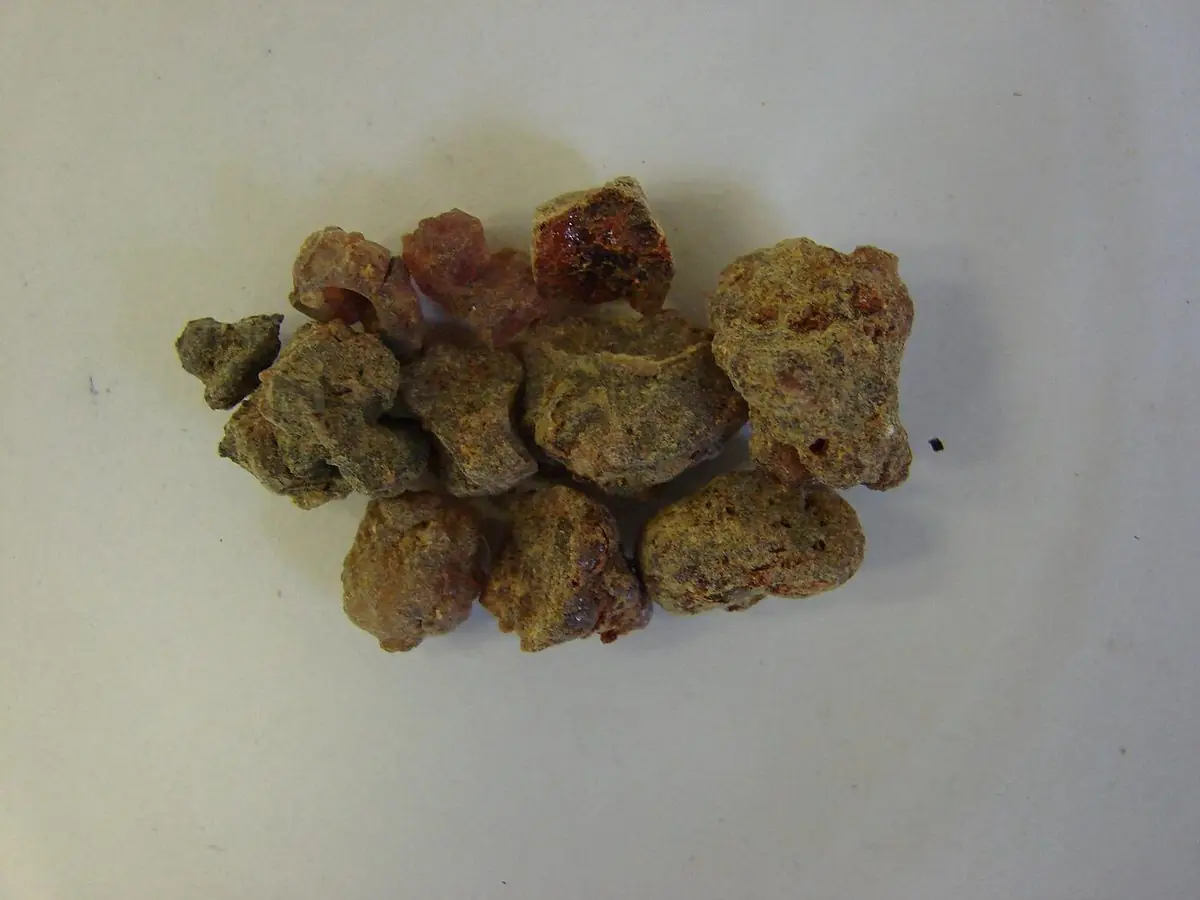
Myrrh is the dried resin of a small, thorny desert tree from Somalia, Ethiopia, and southern Arabia. The ancient world burned it as incense, used it in embalming and perfume, and put it on wounds, and Chinese herbalists took it up from Arab traders as mò yào. A few drops of myrrh tincture in water is still an old-fashioned rinse for sore gums.
Traditional profile
Actions
- astringentTightens and dries tissue; the puckery feel of strong tea, from tannins.
- antimicrobialActs against bacteria, fungi, or other microbes, at least in the lab.
- anti-inflammatoryUsed to calm swelling, redness, and heat in tissues.
- vulneraryHelps wounds heal.
Body systems
Chinese medicine
- Name
- 没药 Mò yào
- Nature
- Neutral
- Flavor
- Bitter, acrid
- Channels
- Heart, Liver, Spleen
- Five phases
- Fire, Metal by flavor
How to know it
A small, knotted, spiny tree or shrub up to about twelve feet, with pale, peeling bark, sparse little leaves of three leaflets that fall in the dry season, and small plum-like fruits.
The resin comes as irregular reddish-brown lumps, or “tears,” somewhat translucent and dusty on the surface. It smells warm and balsamic and tastes intensely bitter; the name comes from the Semitic word for “bitter.”
History & lore
Queen Hatshepsut’s expedition to the Land of Punt around 1470 BCE brought back myrrh trees, shown in the reliefs of her temple at Deir el-Bahari. Herodotus described myrrh packed into bodies during embalming, and it was a base of Egyptian kyphi incense and perfumes.
In the Bible myrrh is part of the holy anointing oil and one of the three gifts of the Magi. Arab traders carried it east, and it entered Chinese materia medica by the Tang dynasty as mò yào, where it is almost always paired with frankincense.
Growing it
Myrrh trees need heat, sun, and very dry, fast-draining soil and cannot take frost. In the warmest parts of Arizona they can be grown in pots or rock gardens and brought in on cold nights, but it takes a mature tree to give resin.
Varieties & companions
Several Commiphora species give myrrh-like resins. The closely related guggul (C. wightii) is a major herb in Ayurveda, and “sweet myrrh” or opopanax comes from C. guidottii. The classic pairing everywhere is frankincense.
Gathering & drying
Harvesters cut the bark in the hot, dry months and return weeks later to collect the resin that has oozed out and hardened. The lumps are sorted by size and color; clean, reddish, translucent tears are best.
At the hearth
Myrrh tincture, a few drops in a small glass of water, was the household rinse for sore gums, mouth ulcers, and sore throats, and it was dabbed on small cuts. Lumps were burned on charcoal as incense.
In the kitchen
Myrrh is too bitter to cook with, though Greeks and Romans added it to wine.
Traditional usage
Resin as tincture, mouthwash, powder, plaster, and incense. Western herbalists used it for mouth and gum problems, wounds, and sore throats. In Chinese medicine mò yào moves the blood and relieves pain and swelling from injury, and helps sores heal.
The dit da jow liniment and the external trauma ointments recorded in Walker and Bauer’s The Ancient Art of Life and Death (2002) almost always pair myrrh with frankincense.
Chinese medicine: bitter and acrid, neutral, entering the Heart, Liver, and Spleen channels.
Chemical constituents
Myrrh is roughly half gum, a third or more resin, and a few percent essential oil. The oil’s furanosesquiterpenes, such as furanoeudesma-1,3-diene and curzerene, give myrrh its smell and are studied for pain-relieving effects.
What the research says
European regulators accept myrrh tincture as a traditional medicine applied to the mouth or skin for minor mouth ulcers, inflamed gums, small wounds, and boils, for adults and children over 12, and advise seeing a doctor if it lasts more than a week. Memorial Sloan Kettering notes that human research on other uses is very limited.
Myrrh is avoided in pregnancy, as it may stimulate the uterus. It may weaken the effect of warfarin, large doses may affect heart rate, and it can cause skin rashes. Chinese practice uses a vinegar-processed form internally because the raw resin upsets the stomach.
Good to know
Myrrh and frankincense come from the same plant family and the same corner of the world, and have traveled together in trade for over three thousand years.
Further reading
- European Medicines Agency: Myrrh herbal summaryWhat European regulators accept, and on what evidence.
- Memorial Sloan Kettering: MyrrhEvidence, side effects, and drug interactions.
- Me & Qi: Mo Yao (myrrh)Chinese medicine properties and uses.