Frankincense
Boswellia sacra
The milky resin of the incense trade, burned in temples for millennia and chewed in Oman today.
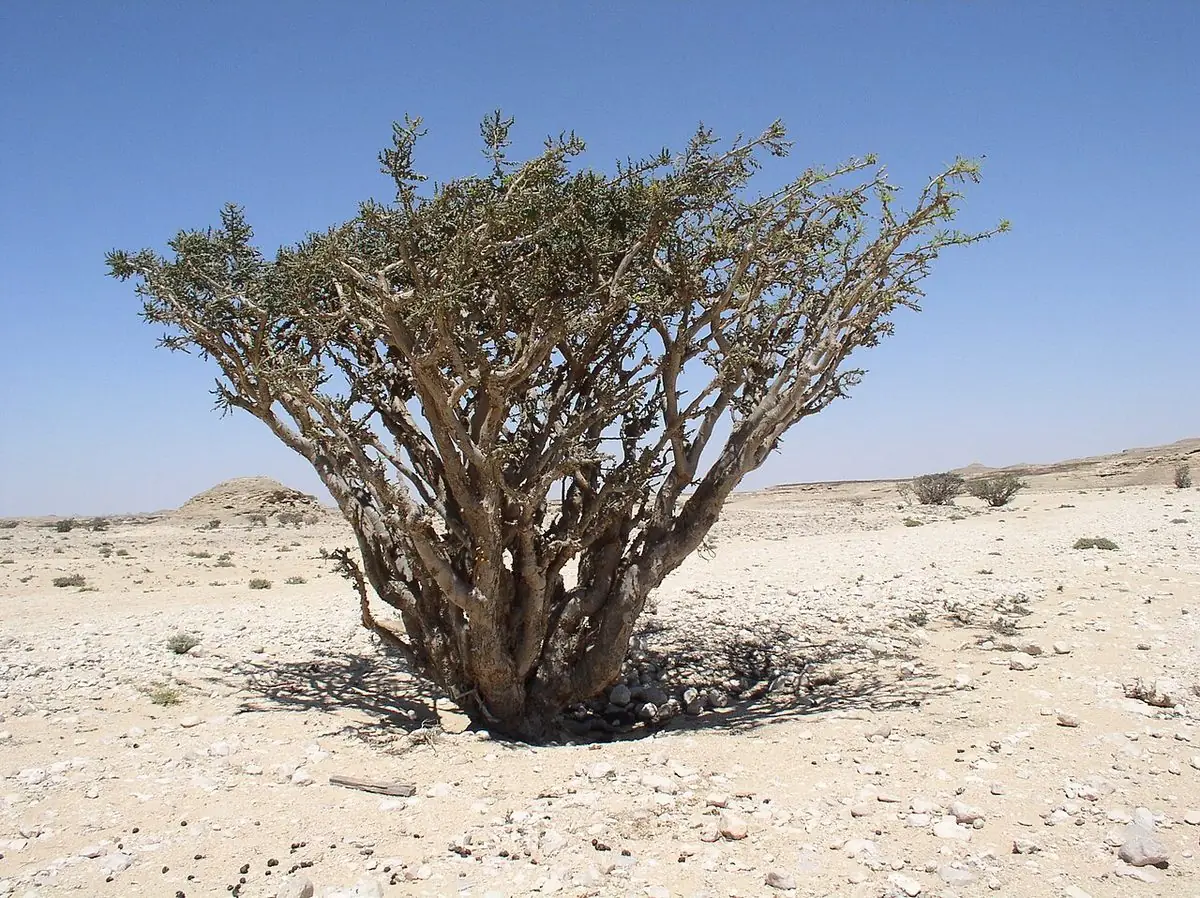
Frankincense is the hardened sap of small, tough trees that grow on the rocky hills of southern Arabia and the Horn of Africa. For thousands of years caravans carried it north along the Incense Route to Egypt, Jerusalem, and Rome, and it is still burned in churches, mosques, and homes. In Chinese medicine it is rǔ xiāng, “milk fragrance,” partner to myrrh in liniments for bruises and aching joints.
Traditional profile
Actions
- anti-inflammatoryUsed to calm swelling, redness, and heat in tissues.
- analgesicEases pain.
- aromaticRich in fragrant oils, which tend to settle the stomach and clear the head.
- astringentTightens and dries tissue; the puckery feel of strong tea, from tannins.
Body systems
Chinese medicine
- Name
- 乳香 Rǔ xiāng
- Nature
- Warm
- Flavor
- Acrid, bitter
- Channels
- Heart, Liver, Spleen
- Five phases
- Metal, Fire by flavor
How to know it
A small tree up to about twenty-five feet, often many-stemmed, with papery, peeling bark, clusters of pinnate leaves at the branch tips, and small white to pale yellow flowers. In Oman it clings to bare limestone slopes and dry riverbeds.
The resin comes as pale, translucent tears from milky white to amber, with a clean, lemony, piney scent that turns sweet and smoky when burned.
History & lore
The name comes from Old French franc encens, “pure incense”; Arabic calls it lubān, from the word for milk. The frankincense trees of Wadi Dawkah and the ancient trading towns of Shisr, Khor Rori, and Al-Baleed in Oman are a UNESCO World Heritage site, the Land of Frankincense.
Egyptians burned it in temples, Pliny wrote that the incense trade made southern Arabia rich, and it is one of the gifts of the Magi. Indian frankincense, from B. serrata, is shallaki in Ayurveda, used for stiff and painful joints.
Growing it
Frankincense trees need heat, full sun, and very dry, stony, fast-draining soil, and they will not survive a hard frost. They can be grown in containers in the warmest parts of Arizona, sheltered in winter, as curiosities rather than resin trees.
Varieties & companions
Several species are traded: B. sacra of Oman and Yemen (the source of prized green-white Hojari), B. carterii of Somalia (often treated as the same species), B. papyrifera of Ethiopia and Sudan, and Indian B. serrata. Its constant companion is myrrh.
Gathering & drying
Harvesters shave small patches of bark, and the milky sap that bleeds out hardens into tears over two or three weeks. Trees are tapped several times a season. Overtapping, grazing, fire, and beetles are shrinking wild stands, and a 2019 study of Ethiopian and Sudanese frankincense forests warned that production could halve within twenty years.
At the hearth
A few tears burned on charcoal have scented homes and places of worship for thousands of years. In Oman people still chew small pieces of the best resin to freshen the breath and settle the stomach.
In the kitchen
Omani households soak a few tears overnight in water and drink the faintly resinous “luban water.” Otherwise frankincense is a fragrance, not a flavoring.
Traditional usage
Resin as incense, chew, water infusion, powder, plaster, and oil. In Chinese medicine rǔ xiāng moves the blood and qi, eases pain, and relaxes stiff sinews; it is used for injuries, joint pain, and slow-healing sores, nearly always with myrrh. In Ayurveda, Indian frankincense is used for joint pain and inflammation.
The dit da jow liniment and the bone-and-sinew ointments recorded in Walker and Bauer’s The Ancient Art of Life and Death (2002) include frankincense among the herbs that carry the formula to the injury.
Chinese medicine: acrid and bitter, warm, entering the Heart, Liver, and Spleen channels.
Chemical constituents
The resin contains boswellic acids, including 11-keto-β-boswellic acid and its acetate (AKBA), the compounds most studied for inflammation, plus incensole acetate, gum, and an essential oil rich in α-pinene and limonene.
What the research says
NCCIH says boswellia taken by mouth may help reduce the pain and inflammation of osteoarthritis, though larger, better studies are needed, and that the evidence for asthma is too thin to judge. Extracts up to 1,000 mg a day have been used safely in trials lasting up to six months.
Chinese medicine avoids frankincense in pregnancy and with a weak stomach, and it may add to the effect of blood thinners. Burning incense indoors adds smoke to the air, so do it in a ventilated room.
Good to know
Look for frankincense sold with its species and origin. Sustainably harvested resin helps keep the wild trees productive.
Further reading
- NCCIH: BoswelliaResearch and safety summary, updated 2025.
- Memorial Sloan Kettering: BoswelliaEvidence, side effects, and drug interactions.
- Me & Qi: Ru Xiang (frankincense)Chinese medicine properties and uses.
- UNESCO World Heritage: Land of FrankincenseThe frankincense trees and trading towns of Oman.