Chamomile
Matricaria chamomilla
Small apple-scented daisies that have earned a place in nearly every cottage garden and kitchen tin.
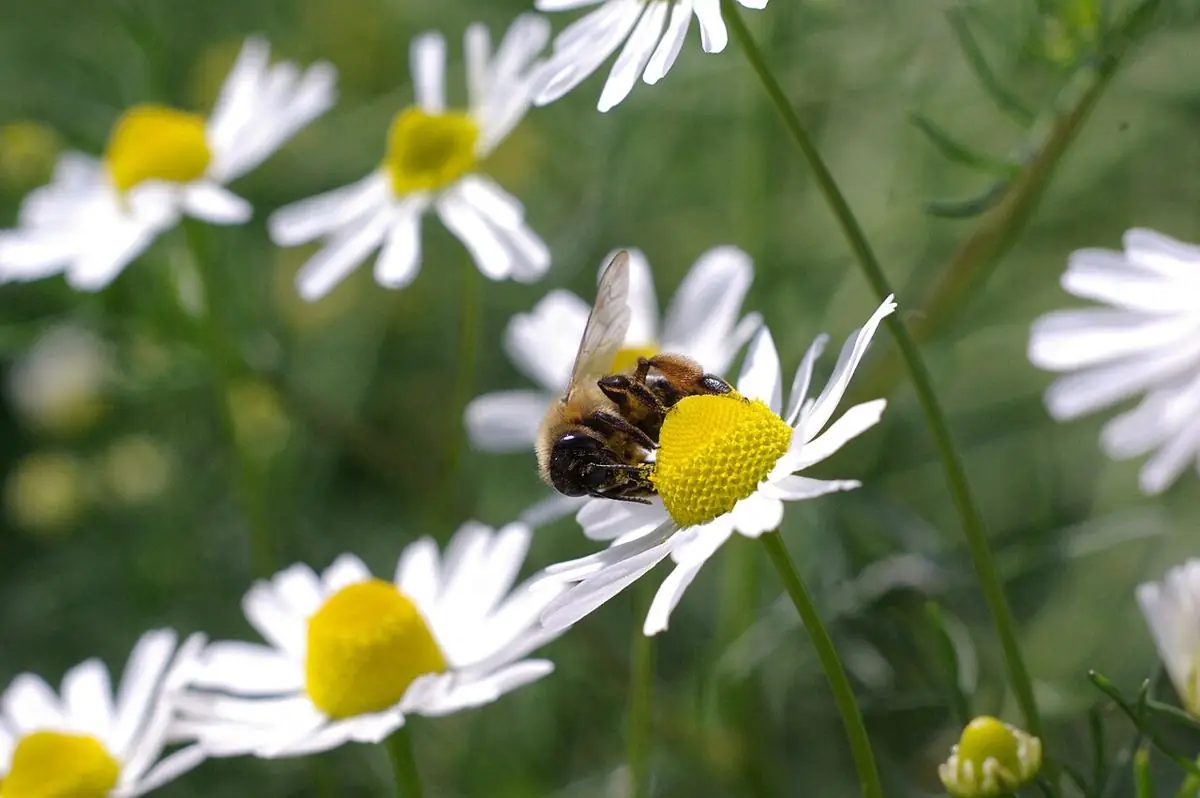
Chamomile’s fine feathery foliage and small white-and-gold flowers have made it a dooryard staple since antiquity, prized as much for its scent as its flowers. Dried and steeped, it is the classic wind-down cup at the end of a long day, and a cooled infusion has long served as a gentle rinse for tired eyes. It self-seeds readily, so one packet of seed tends to become a patch that returns for years.
Traditional profile
Actions
- nervineActs on the nerves: relaxing nervines calm, tonic nervines restore.
- carminativeEases gas, bloating, and colic.
- antispasmodicRelaxes cramping muscle, as in the gut or womb.
- anti-inflammatoryUsed to calm swelling, redness, and heat in tissues.
Body systems
Culpeper (1653)
- Ruling planet
- Moon
How to know it
A branching annual, usually knee-high or less, with leaves cut so finely they look like dill. The flowers are small daisies, a little under an inch across, with white petals around a raised golden dome. As the flower ages the dome swells into a cone and the petals fold back toward the stem.
The surest check is to slice a flower head in half: true chamomile’s cone is hollow inside. Its field look-alikes, scentless mayweed and stinking chamomile, have solid centers, and the flowers don’t smell of green apple when crushed. The petal-less pineapple weed that grows in driveway cracks is a close relative with a similar fruity scent.
History & lore
The Greeks called it khamaimēlon, “ground apple,” for the apple scent of the crushed plant, and the Spanish name manzanilla means the same “little apple.” Grieve records that the Egyptians held it in high regard and dedicated it to their gods.
Two plants have always shared the name. The old English herbals mostly meant Roman chamomile (Chamaemelum nobile), a low perennial that was planted as fragrant lawns and garden seats; the saying went that a chamomile bed, “the more it is trodden, the more it will spread.” The German chamomile on this page is the annual more often grown for tea today.
Gardeners also called it the “plant’s physician,” from the old belief that a drooping plant would perk up if chamomile grew beside it.
Growing it
Scatter the seed on the surface of raked soil in early spring or in autumn and press it in rather than covering it, since it needs light to sprout. Full sun and ordinary, even poor, soil suit it; rich ground mostly gives you leaves. It flowers within a couple of months of sowing and keeps going for several weeks if you keep picking.
Leave a few heads to go to seed at the end of the season and it will come back on its own the next year, often in the paths as well as the bed.
Varieties & companions
For tea, grow German chamomile; the tetraploid variety ‘Bodegold’ has larger flowers and more oil. Roman chamomile is the perennial for paths and lawns, and ‘Treneague’ is a flowerless form bred just for lawns.
It draws hoverflies and small parasitic wasps and does well tucked among cabbages, onions, and other vegetables, where it takes little room.
Gathering & drying
Pick the flower heads on a dry morning once the petals are fully open and lying flat or just beginning to turn back. Pinching them off between two fingers, or combing through the patch with a fork held upside down, is quicker than scissors. Go over the same plants every few days while they bloom.
Spread the heads in a single layer on a screen or paper in a warm, shaded, airy spot. They are ready when the centers crumble between your fingers, usually in one to two weeks. Store them whole in a closed jar away from light.
At the hearth
The flowers are steeped as a plain infusion, and the evening cup is still the use most people know. A strong, cooled infusion has long been used as a final rinse to brighten fair hair, and the dried flowers go into small sleep pillows alongside lavender and hops.
In the kitchen
Beyond the teacup, dried flowers can be warmed in cream or milk and strained to flavor custards, rice pudding, and ice cream, or steeped in honey for a few weeks. The taste is soft and a little like hay and apple.
Traditional usage
The flower heads are the part used. Households made a covered infusion of about a tablespoon of dried flowers to a cup of water just off the boil, steeped five to ten minutes. The same tea, cooled, went into compresses, eye pads, and hair rinses, and a stronger batch was added to bathwater.
Herbalists of the 1600s and later recommended it for colic, restlessness, and poor digestion, and as a steam for colds. Flowers were also infused in oil and rubbed on aching joints.
Chemical constituents
The flowers carry a blue essential oil. The blue comes from chamazulene, which forms from a colorless compound called matricin when the flowers are steamed or distilled, so fresh flowers don’t look blue. The other main oil components are α-bisabolol and its oxides.
Beyond the oil there are flavonoids, chiefly apigenin (mostly as apigenin-7-glucoside) and luteolin; the coumarins herniarin and umbelliferone; and mucilage. Much of the modern research on chamomile looks at apigenin and bisabolol.
What the research says
The U.S. National Center for Complementary and Integrative Health (NCCIH) says studies of chamomile for specific conditions “have not produced sufficient reliable evidence to rate clinical usefulness.” Small studies hint at help for generalized anxiety, and at chamomile mouthwash easing mouth sores during cancer treatment. For sleep, the evidence is thin, and one 2019 review found no benefit.
Europe’s medicines regulator lists chamomile flower as a traditional herbal medicine for minor stomach complaints, mouth and throat irritation, cold symptoms, and minor skin inflammation. That status rests on long, safe use rather than clinical trials.
NCCIH considers the tea likely safe in normal food amounts. Allergic reactions happen, mostly in people sensitive to ragweed and other daisy-family plants. It may interact with warfarin and some other medicines, and its safety in pregnancy isn’t well studied.
Good to know
Chamomile is a daisy-family plant, the same family as ragweed, so people who react to those pollens sometimes react to chamomile flowers as well.
Further reading
- NCCIH: ChamomilePlain-language summary of the research and safety, updated 2024.
- European Medicines Agency: Chamomile flower herbal summaryWhat European regulators accept as traditional use, and why.
- Mrs. M. Grieve, A Modern Herbal (1931): ChamomilesHistory, names, and old uses.
- Nicholas Culpeper, The Complete Herbal (1653)Free public-domain copy at Project Gutenberg.