Astragalus
Astragalus mongholicus
The “yellow leader” of Chinese tonics, simmered by the handful into soups and broths.
Astragalus root, huáng qí, is one of the oldest and most used tonics in Chinese medicine, and one of the gentlest. Long, flat slices of the pale yellow root go into chicken soup, bone broth, and congee to be fished out before serving. Its many American relatives, the milkvetches and locoweeds, are a different story.
Traditional profile
Actions
- tonicStrengthens and restores when taken over time.
- adaptogenSaid to help the body cope with stress and return to balance. A modern term, not an old one.
- immune-stimulantTraditionally used to rouse the body’s defenses against infection.
- diureticIncreases the flow of urine.
Body systems
Chinese medicine
- Name
- 黄芪 Huáng qí
- Nature
- Slightly warm
- Flavor
- Sweet
- Channels
- Spleen, Lung
- Five phases
- Earth by flavor
How to know it
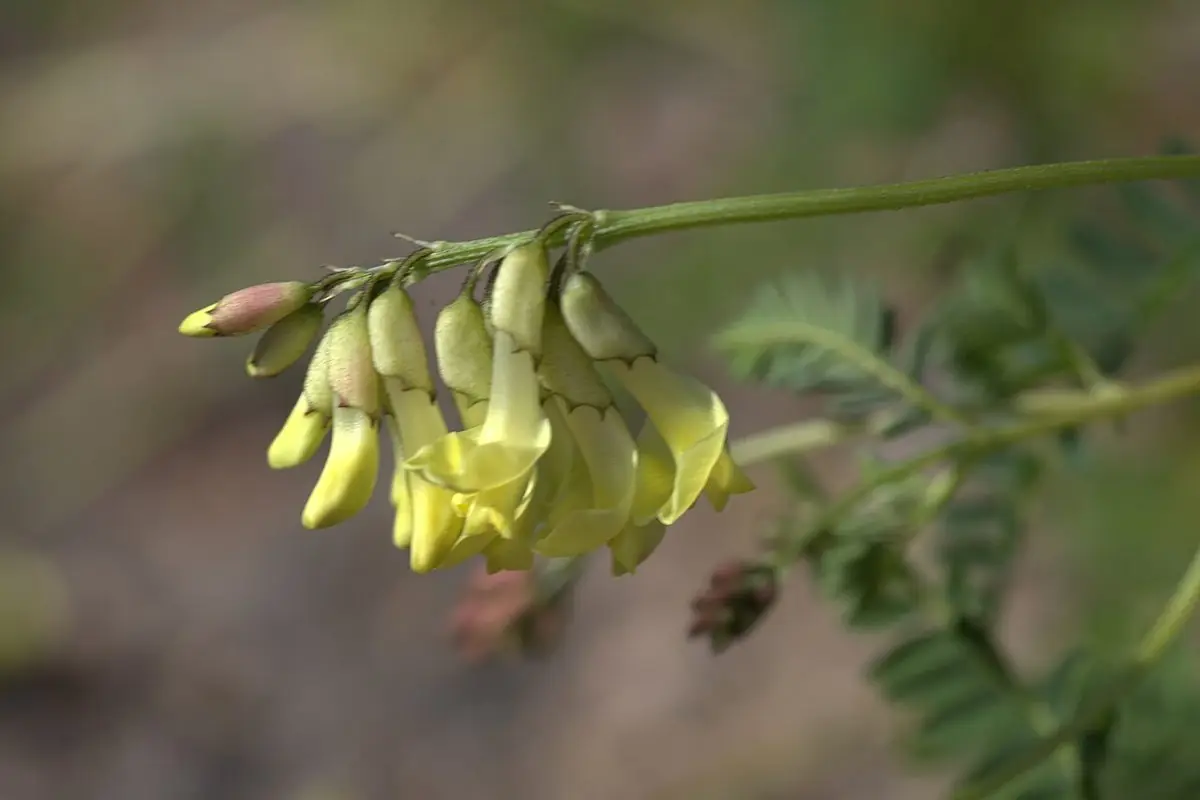
A perennial legume one to three feet tall with feathery leaves of many small paired leaflets, loose spikes of pale yellow pea flowers, and papery pods. The taproot is long, fibrous, and tough, with a yellowish core.
It is sold as long, thin, tongue-shaped slices with a pale cream to yellow cut face, fibrous and slightly sweet, with a faint beany taste.
History & lore
The Shennong Bencao Jing lists astragalus among its highest grade of herbs. Its name is often read as “yellow leader,” the chief of the tonics.
The Yuan dynasty “jade windscreen” powder (yù píng fēng sǎn), astragalus with atractylodes and saposhnikovia, was given to people who caught one cold after another. Li Dongyuan’s 1247 “Dang Gui Blood-Tonifying Decoction” is just astragalus and dang gui in a five-to-one ratio.
Growing it
Astragalus likes full sun and deep, sandy, well-drained soil, and dislikes wet feet, so it suits dry Western gardens. Scratch or nick the hard seed and soak it overnight before sowing. Roots are ready after two to four years.
Varieties & companions
The medicinal root comes from A. mongholicus (long sold as A. membranaceus). There are about 3,000 other Astragalus species, and many North American ones are toxic.
In the soup pot it is paired with dang gui, goji, jujube, and ginger.
Gathering & drying
Dig roots in autumn, cut off the crown and fine rootlets, and dry them in the sun until firm. They are sliced lengthwise at an angle while still slightly flexible.
At the hearth
A handful of slices in the stockpot through the winter is the most common household use in China and Taiwan, especially for people who tire easily or catch every cold.
In the kitchen
Simmer 15 to 30 grams of slices (a small handful) in two to three quarts of soup or broth for an hour or more, then remove them; they are too fibrous to eat. The taste is mild, sweet, and a little earthy. See the <a href="/recipes#recipe-astragalus-dang-gui-chicken-soup">astragalus and dang gui chicken soup</a>.
Traditional usage
Root as decoction, soup, powder, and syrup. In Chinese medicine it is the main herb for “tonifying qi” and “securing the exterior”: for fatigue, poor appetite, frequent colds, sweating easily, slow-healing sores, and swelling.
In the classical recovery formulas described in Walker and Bauer’s The Ancient Art of Life and Death (2002), such as the Restore the Spleen decoction (guī pí tāng), astragalus builds energy alongside ginseng or codonopsis.
Chinese medicine: sweet, slightly warm, entering the Spleen and Lung channels; a qi tonic.
Chemical constituents
The root contains polysaccharides, saponins such as astragaloside IV, and isoflavonoids including calycosin and formononetin, along with amino acids and trace minerals.
What the research says
NCCIH says there isn’t enough reliable evidence to know whether astragalus helps any condition, though recent reviews of mostly Chinese studies point to possible effects on immune function, blood sugar with metformin, and some kidney diseases. Doses up to 60 grams a day for four months have not caused problems in studies.
People with autoimmune diseases are advised to avoid astragalus, and it may interact with drugs that suppress the immune system, such as those taken after an organ transplant. Animal research raises concern about use in pregnancy. Chinese practice avoids it at the start of a feverish cold.
Good to know
Never gather wild milkvetch or locoweed in the American West. Many of these Astragalus species poison livestock with swainsonine or build up toxic selenium, and several grow wild in Arizona.
Further reading
- NCCIH: AstragalusResearch and safety summary, updated 2025.
- Memorial Sloan Kettering: AstragalusEvidence, side effects, and drug interactions.
- Me & Qi: Huang Qi (astragalus root)Chinese medicine properties and uses.
- University of Arizona Cooperative Extension: A Guide to LocoweedThe toxic wild relatives that grow in Arizona.