Goldenrod
Solidago canadensis & kin
Plumes of gold at the end of summer, unfairly blamed for the hay fever that ragweed causes.
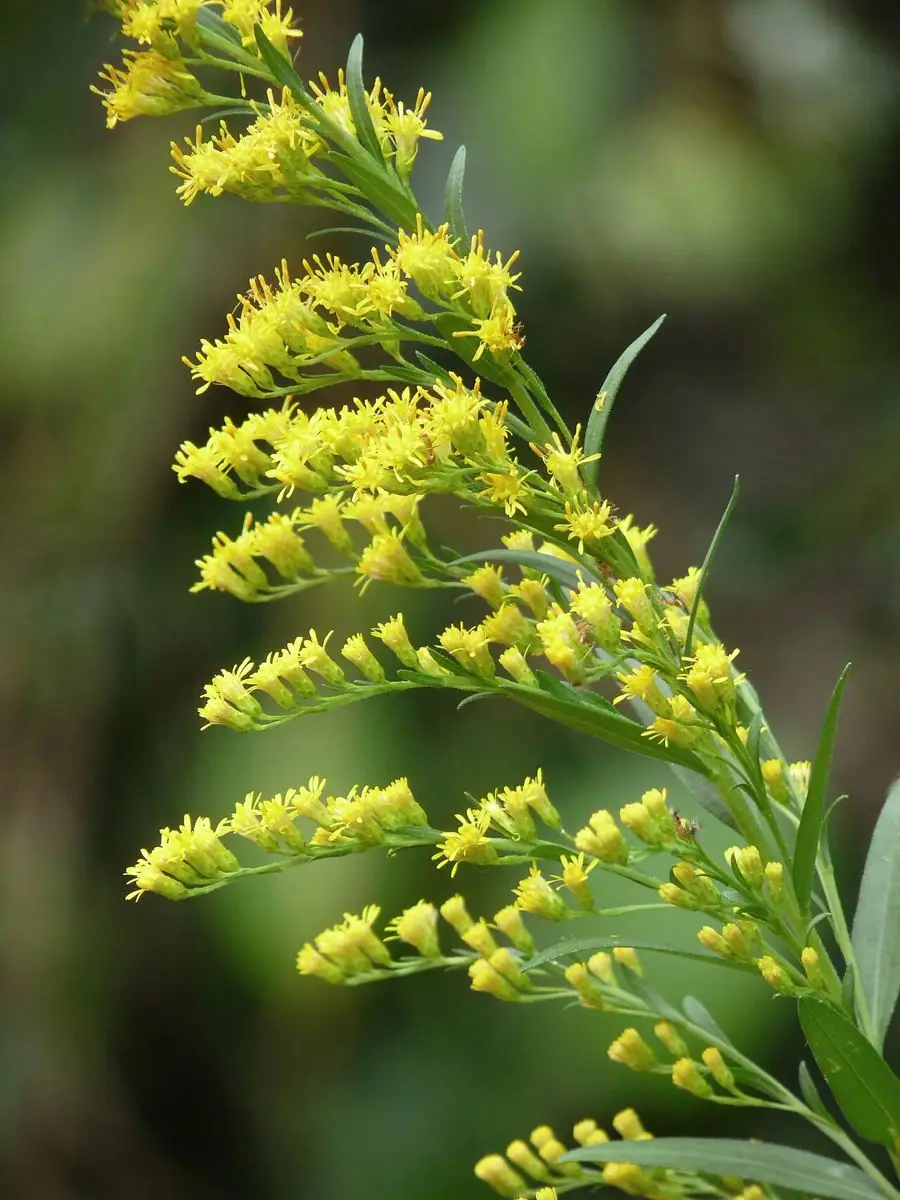
Goldenrod turns old fields and roadsides yellow from August into October. It is often blamed for hay fever, but its heavy pollen is carried by insects, not wind; the real culprit is ragweed, which blooms at the same time. Nations from the Zuni to the Iroquois used it for tea, sore throats, and fevers, and settlers made a “Liberty tea” from its sweet-scented cousin.
Traditional profile
Actions
- diureticIncreases the flow of urine.
- anti-inflammatoryUsed to calm swelling, redness, and heat in tissues.
- astringentTightens and dries tissue; the puckery feel of strong tea, from tannins.
- diaphoreticBrings on a sweat; used at the start of a cold or fever.
Body systems
Culpeper (1653)
- Ruling planet
- Venus (European goldenrod)
Native nations kept their own medical knowledge, and much of it was never written down or was recorded by outsiders. The uses on this page are the ones published in ethnobotanical records and credited to the nations named; they aren’t mapped onto Chinese or Ayurvedic systems, which don’t belong to them.
How to know it
A perennial two to five feet tall with a single leafy stem, narrow, toothed leaves with three faint parallel veins, and arching, one-sided plumes of tiny golden flower heads at the top. It spreads by roots into large colonies.
There are dozens of North American species. Canada goldenrod is the common tall one of fields. Sweet goldenrod (S. odora) has leaves that smell of anise when crushed. European goldenrod (S. virgaurea) is the species in European herbals.
History & lore
USDA records credit the Zuni with chewing the flowers for sore throats and drinking a flower tea for body aches, the Potawatomi and Okanagan-Colville with infusions for fevers and flu, the Shuswap with using it in baths after childbirth, the Gosiute with eating the seeds, and the Iroquois with many flower and root preparations.
The genus name Solidago means “to make whole.” After the Boston Tea Party, American colonists drank sweet goldenrod as one of several “Liberty teas.” Goldenrod is the state flower of Kentucky and Nebraska, and Thomas Edison spent his last years trying to make rubber from a Florida species.
Culpeper wrote of European goldenrod that “Venus claims the herb” and praised it for the kidneys and bladder.
Growing it
Very easy in sun and almost any soil. Canada goldenrod spreads aggressively, so in a garden choose clumping species or cultivars.
Varieties & companions
Better-behaved garden goldenrods include ‘Fireworks’ (S. rugosa), ‘Golden Fleece’ (S. sphacelata), showy goldenrod (S. speciosa), and stiff goldenrod. Sweet goldenrod is the one to grow for tea.
Goldenrod is one of the most important late-season plants for native bees, honeybees, and migrating monarchs. Plant it with asters, which bloom alongside it in purple.
Gathering & drying
Cut the flowering tops when the flowers are just opening, before they go to fluff. Hang them in small bundles in the shade. Pick leaves of sweet goldenrod through summer for tea.
At the hearth
A tea of the flowering tops was a traditional drink for colds and sore throats and was used to flush the kidneys. The flowers give a clear yellow dye for wool.
In the kitchen
The flowers make a honey-colored tea and can be added to fritters and salads. Sweet goldenrod leaves make a pleasant anise-flavored tea on their own.
Traditional usage
Flowering tops and leaves as tea, gargle, and wash; roots in some Iroquois and Navajo preparations. Recorded uses focus on sore throats, fever, colds and flu, body aches, and the urinary tract.
Native nations kept their own medical knowledge, and much of it was never written down or was recorded by outsiders. The uses on this page are the ones published in ethnobotanical records and credited to the nations named; they aren’t mapped onto Chinese or Ayurvedic systems, which don’t belong to them.
Chemical constituents
Goldenrods contain flavonoids (quercetin, rutin, and kaempferol glycosides), phenolic acids, triterpene saponins, and clerodane diterpenes, plus a small amount of essential oil rich in α-pinene and germacrene D. European goldenrod also contains the phenolic glycoside leiocarposide.
What the research says
European regulators list European goldenrod (S. virgaurea) as a traditional herbal medicine to increase urine flow in minor urinary complaints, based on long use. Canada goldenrod has very little human research.
It is generally well tolerated. People allergic to daisy-family plants may react to it, and anyone told to restrict fluids for heart or kidney problems shouldn’t use it to increase urine.
Good to know
Goldenrod pollen is heavy and sticky and rarely causes hay fever. If you sneeze in late summer, look for ragweed, whose small green flowers shed wind-blown pollen at the same time.
Further reading
- USDA NRCS Plant Guide: Canada goldenrodRange and recorded uses by named nations.
- European Medicines Agency: European goldenrod herbal summaryWhat European regulators accept, and on what evidence.
- Nicholas Culpeper, The Complete Herbal (1653)Free public-domain copy at Project Gutenberg.