Curry Leaf
Murraya koenigii (Bergera koenigii)
Glossy aromatic leaves that crackle in hot oil at the start of South Indian cooking.
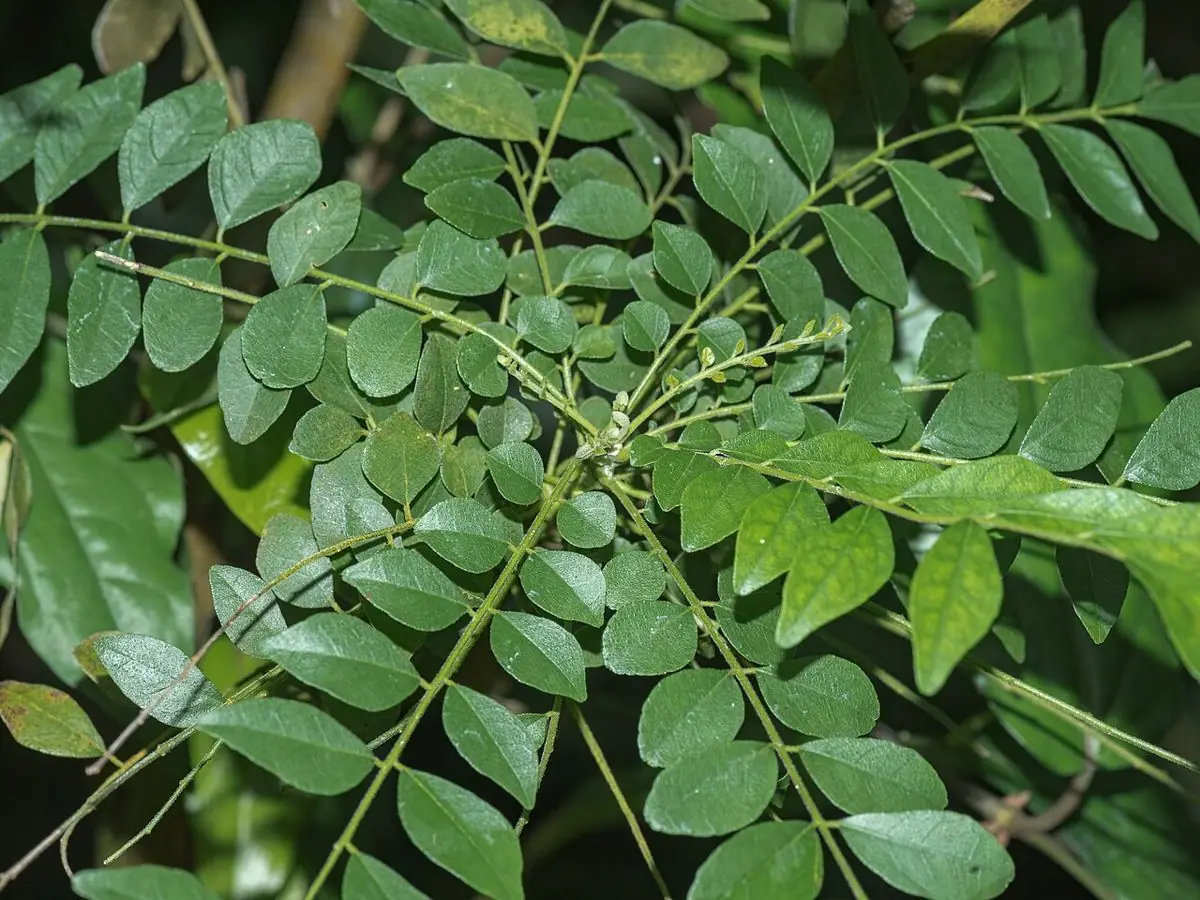
Curry leaf has nothing to do with curry powder. It is a small citrus-family tree whose shiny leaflets smell of citrus, anise, and something savory all at once. In South India and Sri Lanka a sprig fried in hot oil with mustard seeds, the tadka, begins countless dals, chutneys, and vegetable dishes.
Traditional profile
Actions
- carminativeEases gas, bloating, and colic.
- aromaticRich in fragrant oils, which tend to settle the stomach and clear the head.
- antioxidantRich in compounds that protect cells from oxidative damage.
Body systems
How to know it
A small tree or shrub with pinnate leaves of 11 to 21 glossy, pointed leaflets, clusters of small white fragrant flowers, and small berries that ripen from green to shiny black. The crushed leaves have a strong, warm, citrusy smell.
Some botanists now place it in the genus Bergera. Don’t confuse it with “curry plant” (Helichrysum italicum), a silvery Mediterranean herb that only smells a little like curry.
History & lore
Curry leaf has been used in the cooking of southern India for many centuries and is mentioned in early Tamil and Kannada literature. It is so common in Kerala and Tamil Nadu that many households keep a tree by the kitchen door.
In Ayurvedic and Siddha household medicine, the leaves are eaten for the digestion and used in hair oils, which is why coconut oil boiled with curry leaves is a traditional hair tonic.
Growing it
It needs warmth and sun, well-drained soil, and protection from frost. In southern Arizona grow it in a large pot and bring it inside in winter, or plant it in a sheltered spot. Pick leaves often to keep it bushy.
Varieties & companions
Gardeners distinguish a regular type, a dwarf type with smaller, more aromatic leaves, and a “gamthi” type with thick, strongly scented leaves. Grow it with citrus in pots on a sunny patio.
Gathering & drying
Strip leaflets from the stem as needed. They are best fresh; frozen leaves keep much better than dried ones, which lose most of their scent.
At the hearth
Chewing a few fresh leaves on an empty stomach is a household habit in parts of South India. Coconut oil simmered with curry leaves until crisp is massaged into the scalp.
In the kitchen
Heat oil, add mustard seeds until they pop, then drop in a sprig of curry leaves for a few seconds before adding onions or pouring the whole tempering over dal. Grind fresh leaves into chutney or dry-fry and powder them with lentils as karivepaku podi.
Traditional usage
Leaves as seasoning, chutney, powder, and hair oil; bark and roots in some Siddha and Ayurvedic preparations. Household uses center on digestion, loss of appetite, and hair and scalp care.
Chemical constituents
The leaves contain carbazole alkaloids unique to the plant’s family, such as mahanimbine, girinimbine, and koenimbine, which are the subject of much lab research. The aroma comes from an essential oil with β-caryophyllene, α-pinene, sabinene, and other terpenes, in amounts that vary by region.
What the research says
There are almost no human trials of curry leaf. Lab and animal studies have looked at its antioxidant, anti-inflammatory, and blood-sugar-lowering effects, but those results can’t be applied to people yet.
Curry leaves in food are safe. The ripe berries are edible, but the seeds inside are considered poisonous, so spit them out.
Good to know
Curry leaf trees can carry the Asian citrus psyllid, the insect that spreads citrus greening disease, so moving the plants is restricted in citrus-growing states. Buy from a licensed local nursery.
Further reading
- Wikipedia: Curry treeBotany, names, and culinary use.